


Phil Lord and Christopher Miller’s adaptation of Andy Weir’s Project Hail Mary opened to $80.6 million domestically, the second-strongest debut in a decade for a non-franchise film, behind only Christopher Nolan’s Oppenheimer. Two weekends in, the film has already crossed $300 million globally, becoming Amazon MGM’s highest-grossing release in company history and drawing comparisons from critics to Arrival, Interstellar, and Dune. The commercial success comes as Ryan Gosling’s portrayal of Dr. Ryland Grace earned a 95% certified fresh score on Rotten Tomatoes, with reviewers singling out his ability to sustain a one-man show across a two-hour runtime with a combination of physical comedy and genuine emotional weight. With a second-weekend box office drop that outperformed both Oppenheimer and Dune: Part Two, the film is now tracking toward a total that could challenge $600 million globally, and that trajectory all but guarantees a sequel.
Weir published Project Hail Mary four years after his novel The Martian was adapted into a $630 million global hit in 2015. Both books share the same formula of a scientist alone in a hostile environment, problem-solving his way toward survival against impossible odds. That formula translates to cinema because it is fundamentally a character study wrapped around hard science. However, there are dozens of science fiction novels currently sitting on shelves that carry the same cinematic potential, books that have never been adapted despite decades of evidence that audiences will show up for the exact kind of story they tell.
5) Gateway
Image courtesy of Del Rey
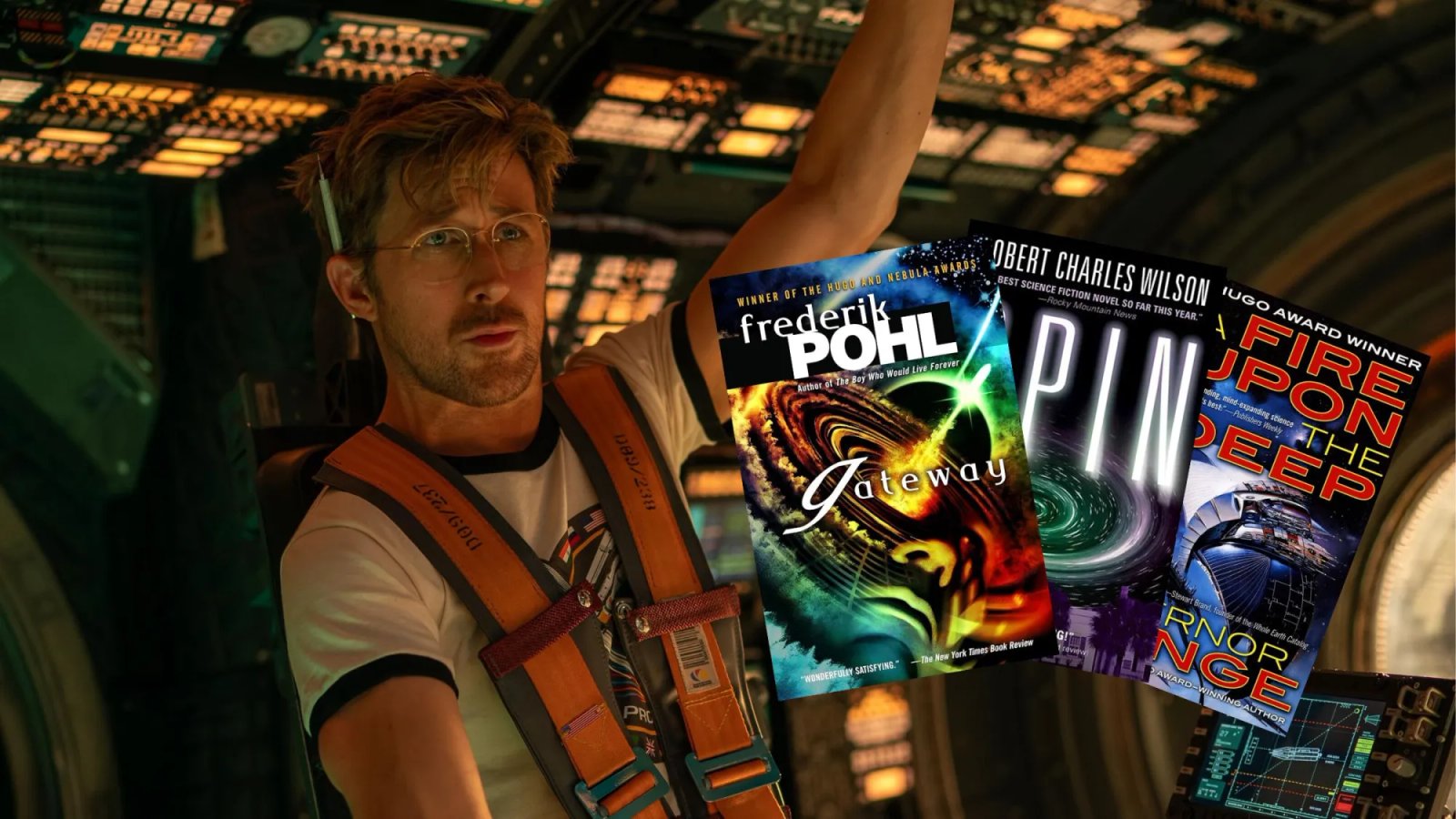
Frederik Pohl published Gateway in 1977 and collected the Hugo, Nebula, Locus, and Campbell Memorial Awards in the same year, a clean sweep that has never been replicated in sci-fi. The novel follows Robinette Broadhead, a lottery winner who travels to an asteroid where alien spacecraft, left behind by a vanished civilization called the Heechee, sit available for departure. However, nobody understands the navigational controls, and passengers set off without knowing their destination, the duration of the trip, or whether they will return. Pohl structures Gateway across two parallel timelines, one following Broadhead on Gateway as he summons the nerve to board another ship, the other set years later as he processes his trauma in therapy sessions with an AI psychiatrist named Sigfrid von Shrink. The tension between those two timelines, and the gradual revelation of what Broadhead is protecting himself from remembering, gives Gateway a psychological architecture that commercial science fiction cinema consistently rewards.
4) Spin
Image courtesy of Tor Science Fiction
Robert Charles Wilson won the Hugo Award for Spin in 2006 with one of the most deceptively simple premises in contemporary science fiction. One night, the stars disappear as an unknown intelligence encloses Earth inside a membrane, slowing the planet’s relationship to external time. That means while humans experience a normal day inside the barrier, thousands of years pass in the rest of the universe. Wilson grounds that cosmic scale through three characters who have known each other since childhood, tracking how each responds to a transformation so total it dismantles every human institution from religion to government to scientific ambition. That combination of the infinite and the intimate is precisely what Project Hail Mary deployed so effectively, which means a Spin adaptation in the right hands would deliver similar thrills.
3) A Fire Upon the Deep
Image courtesy of St Martin’s Press
Vernor Vinge, who died in March 2024, won the Hugo Award for A Fire Upon the Deep in 1993, sharing it with Connie Willis’s Doomsday Book. In the novel, Vinge divides the galaxy into physical zones based on their capacity for intelligence: the Unthinking Depths at the galactic core, where sentient thought cannot function; the Slow Zone in the middle, where Earth sits; and the Beyond, where faster-than-light travel and superintelligent civilizations are physically possible. The story kicks off as a human colony in the Beyond accidentally releases an ancient AI predator called the Blight, which begins consuming civilizations. The only countermeasure may be buried on a planet in the lower zones, one populated by the Tines, creatures whose individual members merge into pack-minds to form complete personalities. The Tines civilization alone, entities that grieve when a pack member dies because the group loses a piece of its shared consciousness, contains enough conceptual material to anchor an entire film.
2) Blindsight
Image courtesy of Tor Books
Peter Watts Blindsight remains the most intellectually unsettling first-contact novel. In the book, Earth has been photographed in a single coordinated burst by thousands of alien probes, and humanity’s response is the Theseus, a spacecraft crewed by a group of heavily modified specialists: a linguist with four distinct personalities sharing one body, a biologist who has replaced her organic limbs with machine prosthetics, a soldier wired directly into the ship’s tactical systems, and a narrator with half his brain surgically removed in childhood. Their mission takes them to the edge of the solar system, where something vast and genuinely alien is waiting. The novel questions whether consciousness itself is a functional advantage or a costly liability in the architecture of any intelligence. In 2026, as machine consciousness moves from philosophical abstraction to a question occupying researchers and regulators, that premise carries a force that Watts could not have anticipated.
1) The Stars My Destination
Image courtesy of Gollancz
Alfred Bester published The Stars My Destination in 1956, and it influenced enough writers over the following seven decades that entire genres owe it a direct structural debt. In a future where human beings have developed the ability to teleport by willpower alone, Gully Foyle is the sole survivor of a destroyed spacecraft, adrift in deep space for months until a passing ship spots his distress signal and deliberately ignores it. That decision transforms a man his own records describe as unremarkable and below average in every measurable capacity into one of literature’s most terrifying protagonists, as Foyle redirects every resource at his disposal toward finding the ship that abandoned him and destroying everyone aboard. Bester borrowed the architecture of The Count of Monte Cristo and detonated it across a future dense with invention. Despite that density, the emotional engine driving the entire novel is viscerally simple, as a man society deemed worthless discovers that worthlessness, properly directed, is more dangerous than brilliance.
Which science fiction novel do you most want to see adapted for the big screen? Leave a comment below and join the conversation now in the ComicBook Forum!
