


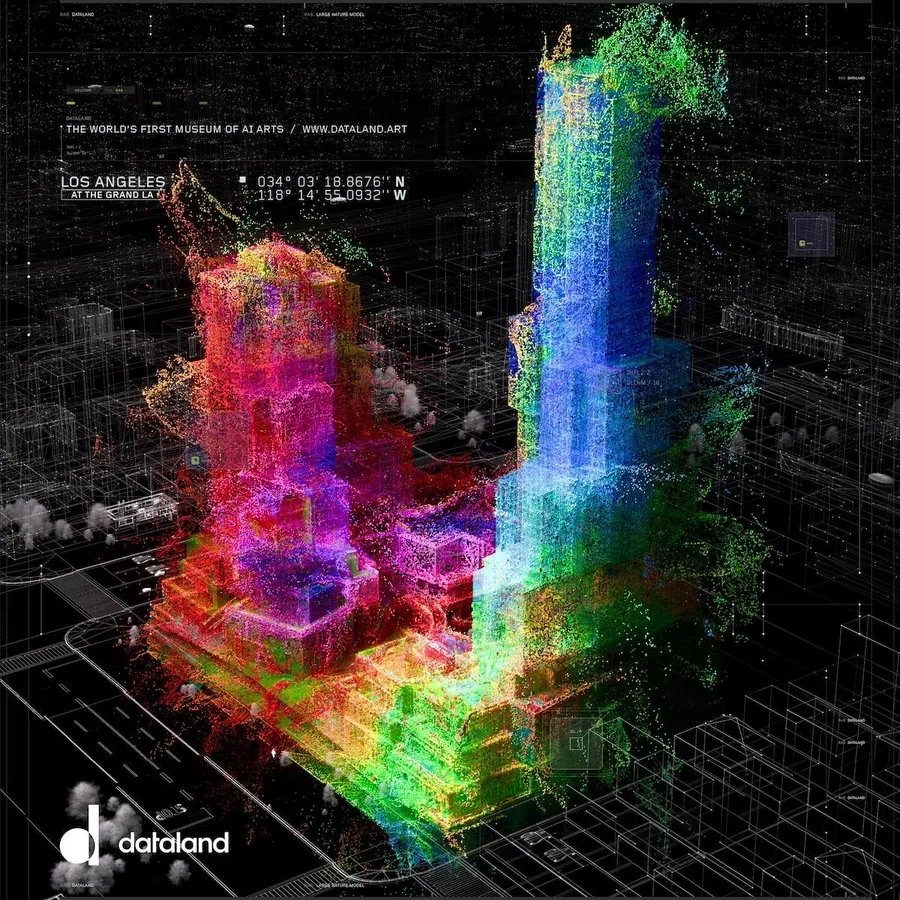
The Grand LA complex, as reimagined by AI artist Refik Anadol.
Courtesy of Dataland
Refik Anadol has long been obsessed with Los Angeles, from the time he watched Blade Runner at 8 years old. He made the city his home in 2012, moving from Istanbul to attend UCLA’s Department of Design Media Arts. This spring, Anadol, with co-founder Efsun Erkiliç, will open Dataland in downtown Los Angeles, expected to be the world’s first museum built from the ground up with AI art as its sole focus.
Spanning 25,000 square feet across five galleries, the museum’s home is the Frank Gehry-designed mixed-use development, The Grand LA. It sits directly across the street from Walt Disney Concert Hall, which Anadol bathed in projections in 2018 (WDCH Dreams) using 100 years of LA Philharmonic recordings and archives mapped onto the concert hall’s undulating stainless-steel skin. The effect was as if the building itself was hallucinating, what the New York Times called “a sort of combinatorial fantasia.”
Turkish-born Anadol is a Los Angeles-based media artist working at the nexus of artificial intelligence and data visualization. His work takes large datasets—musical archives, natural ecosystems and urban infrastructure—and renders them into large-scale immersive installations.
“L.A. has long been a city that looks to the future in art, music, cinema, architecture, and more, and it feels natural to open Dataland here,” said Anadol in press materials.
To date, Anadol’s work has lived in borrowed spaces—MoMA, London’s Serpentine Galleries, Las Vegas’ Sphere and the facade of Antoni Gaudí’s famed Casa Batlló in Barcelona, among others.
Dataland will feature five galleries spread across 25,000 square feet.
Courtesy of Dataland
The scale, vivid color, shapes and kinetic spectacle of the artist’s work is reliably crowd-pleasing, which should help bank his decision to build a museum. In 2022 and 2023, his work, Unsupervised, ran at MoMA, drawing nearly three million visitors.
Dataland employs a Large Nature Model with extensive photos and field recordings of nature.
Courtesy of Dataland
The art world establishment, in fact, took notice when MoMA acquired Unsupervised, the first generative AI work to enter the museum’s permanent collection. While Anadol’s art draws crowds, he has detractors who say his work is conceptually thin. Jerry Saltz, the Pulitzer Prize-winning senior art critic at New York magazine, skewered Unsupervised opening as “a massive techno lava lamp,” and “a half-million-dollar screensaver,” according to a report in Artnet.
Anadol responded, in part, by noting that 22 out of 24 reviews of Unsupervised were favorable.
Refik Anadol with co-founder Efsun Erkiliç.
Courtesy of Dataland
What Dataland Visitors Will Experience
As a whole, the museum is organized around the Large Nature Model, the studio’s open-source AI that’s trained specifically on nature data. That encompasses field recordings, high-resolution imagery captured in 16 rainforest locations, biodiversity archives, and 2.4 million images of flora, fauna and fungi. Additionally the model includes sound recordings, pigment analyses and biosensor signals.
Perhaps the clearest preview of what Dataland will feel like comes from Gallery C, the Infinity Room, a 12-foot square mirrored cube with every side a projection surface. There, symmetrical pulses of black-and-white imagery will undulate paired with “AI-generated scents from Large Nature Model,” according to press materials. The olfactory immersion should be nuanced, as the model has been trained on half a million scent molecules. In 2014, Anadol built an original version at UCLA, his first immersive data sculpture. The installation has since traveled to 35 cities.
The Infinity Room will be the first immersive environment to use World Models, an advanced class of generative AI that comprehends real-world physics and spatial dynamics, allowing the imagery to move according to the rules of the physical world. In other words, the room won’t just look like nature, it will seem to move like it, providing a decidedly trippy experience.
The Infinity Room is a 12-foot-square mirrored cube with every side serving as a projection surface.
Courtesy of Dataland
The other four galleries have not been revealed, but visitors should be able to navigate through the results of the Large Nature Model—those 2.4 million images of flora, fauna, and fungi, organized by the machine’s own logic of relation.
While Dataland bills itself as “the world’s first Museum of AI Arts,” other AI artists’ works, while not housed in dedicated museums, have been significant. Two centers in Europe cover the full spectrum of media and technological art:
The ZKM Center for Art and Media in Karlsruhe, Germany (termed the “digital Bauhaus”) has been exhibiting AI and media art since 1989 and holds a permanent collection that includes AI installations. The Ars Electronica Center in Linz, Austria, has been doing similar work since the late 1970s.
