


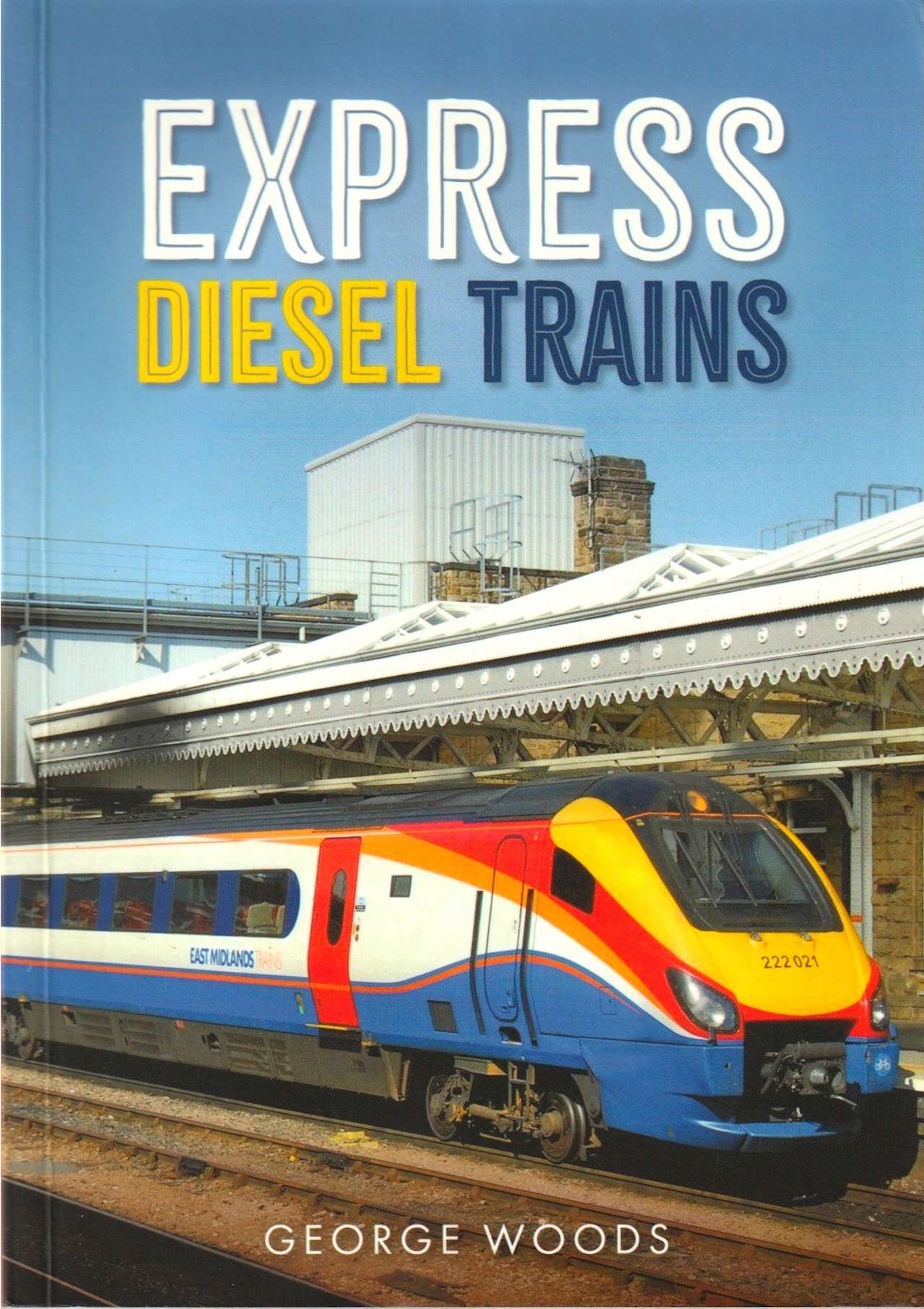
Express Diesel Trains by George Woods describes the evolution of Britain’s high-speed trains from 1968, when a prototype of the familiar Class 43 HST was developed.
They attained speeds never imagined in steam days, with 125 mph an everyday occurrence. Later came the Class 180 Adelantes, the Class 220/221 Voyagers, and the latest Azuma trains, which are increasingly monopolising long-distance travel in the UK.
Published in October 2023 by Amberley Publishing and written by Adam Head, this soft-cover book measures around 23.4 cm x 16.5 cm, has 96 pages and 180 illustrations.
It has a published price of £15.99, but at the time of writing, it can be purchased for £14.39 from Amberley Publishing and for £12.39 from Amazon.
A three-page introduction describes how the advent of high-speed travel also brought about a veritable revolution in the kaleidoscopic variety of liveries that adorned Britain’s trains.
Many of the trains covered by the book are Class 43 HSTs, and could be seen throughout the UK. The author has taken the sensible option by not dividing the book into separate sections, but grouping photographs by train operators and their routes.
In 1968, British Rail introduced a prototype train that would revolutionise rail travel and form the backbone not only of BR services, but also of those of the companies that took over after the privatisation of the railways in 1994.
This, of course, was the High Speed Train, which introduced 125 mph speeds to the UK and cut journey times as never before.
Other fast diesels, such as the Class 220 and Class 180, followed, but none have had the impact or long-term success of the 125. The latest Azuma trains, at the current forefront of high-speed travel, are also featured.
For those old enough to remember when HSTs were introduced, the photographs below will bring back memories of those days, with their smart blue-and-yellow livery.
Express Diesel Trains pages 8/9. // Credit: RailAdvent
These scenes typify the great variations introduced by different operators, although the ones on the right hark back to the corporate InterCity livery.
Voyagers became synonymous with long-distance cro-country services, initially with Virgin Trains and later with CrossCountry. It is characteristic of most HST’s that the livery designers have produced some excellent results in keeping with the design of the trains.
Express Diesel Trains pages 74/75. // Credit: RailAdvent
The livery designer’s artistic talents are seen again with the Class 180 Adelantes seen below. Also clearly seen on the right are Hull Trains’ use of the ‘neon’ livery that was once seen on trains operated by Hull Trains’ sister company, First Great Western.
Express Diesel Trains pages 88/89. // Credit: RailAdvent
For a book that would at first sight have a limited scope, the author has produced an excellent volume. The quality of the photographs is generally superb, both for trains at stations and in scenic landscapes. The grouping by operator and livery is a good choice, and the excellent captions supplement the superb photography. Although other types of express diesel trains continue in daily use, this book will prove to be a valuable contribution to their service from the west of England to Northern Scotland, and fully deserves a rating of 5/5.
The book is available to purchase from Amazon and from Amberley Publishing.
We would like to thank Amberley Publishing for providing us with a copy of the book for review.
