


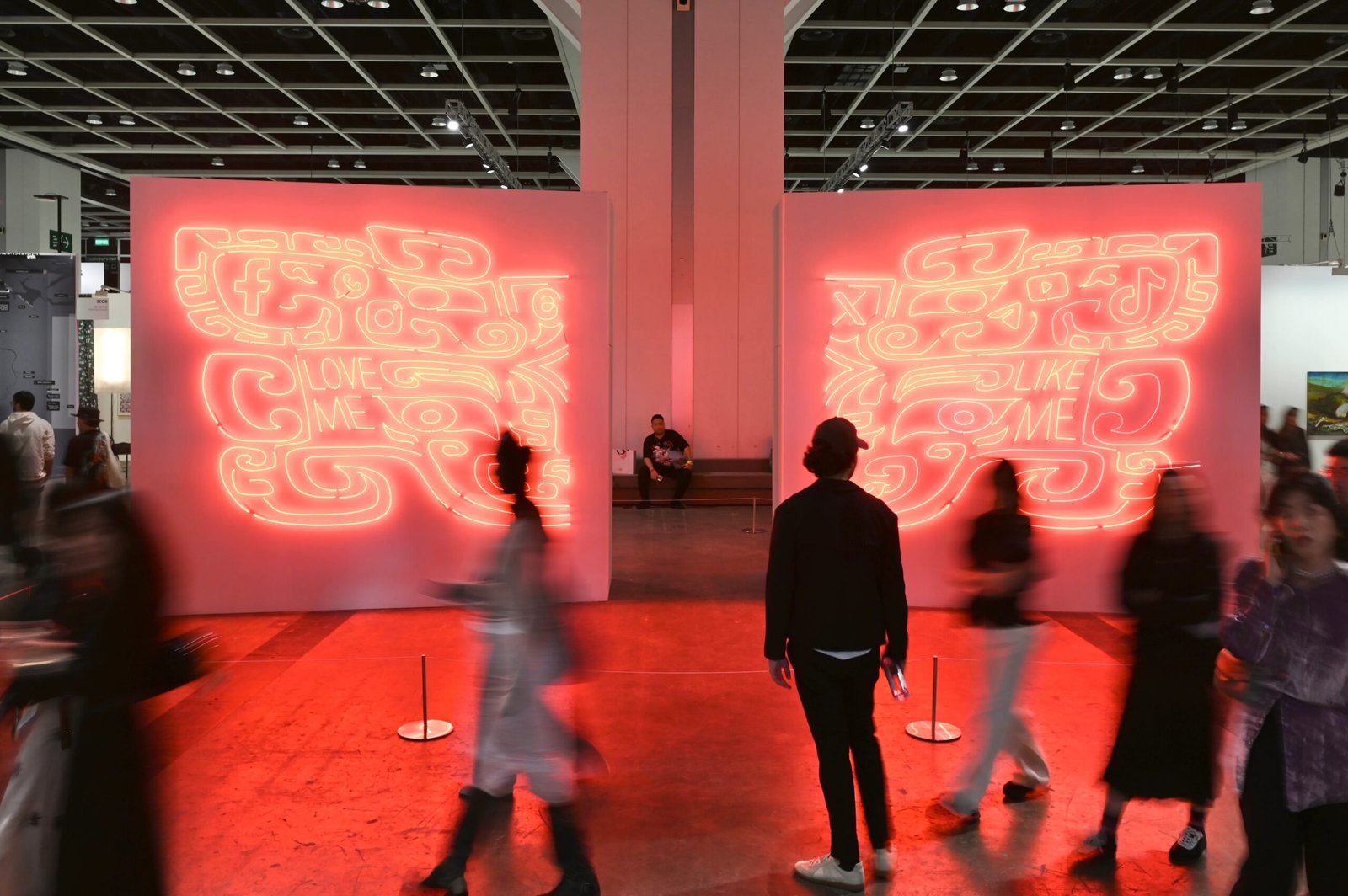
Art Basel Hong Kong runs through March 29, featuring 240 galleries with a strong presence this year of both emerging and established names from the region. Photo by Li Zhihua/China News Service/VCG via Getty Images
The energy at this year’s Art Basel Hong Kong, particularly during the VIP preview, was noticeably different. The aisles filled quickly, but primarily with attendees from the region, and the brief VIP window felt too short to complete a full lap of the first floor before the crowds rushed in. Whether this was good or bad is a matter of perspective. For seasoned collectors like Alain Servais, it left too little time to properly engage with the art, but for many younger local collectors and enthusiasts, it contributed to the overall sense of excitement and momentum.
There’s been undeniable optimism and enthusiasm in Hong Kong this week—especially compared to last year. Much of it traces back to long-term public investments in the city’s now expansive, top-tier institutional system, anchored by M+ and the West Kowloon cultural district, as well as a surge of experimental arts initiatives across the city’s new galleries, satellite fairs and salons. “Hong Kong is back, with a refreshed energy,” director Angelle Siyang-Le told Observer at the opening. While the ongoing war in Iran raises concerns about security and sustainability, she believes that Asia, and particularly mainland China, has grown resilient in recent years, to the point of almost seeming isolated from world events, even as dealers this year have had to cope with rising costs and shipping issues caused by the conflict.
Art Basel Hong Kong in 2026 is notably more context-specific, with more than half of the 240 galleries hailing from the APAC region, aligning with the fair’s role as a key platform for bridging the art worlds of Europe and Asia and offering valuable visibility for emerging voices in the local ecosystem. Collectors at the VIP preview were predominantly from the region, with strong representation from Hong Kong, mainland China, Taiwan, Korea, Japan and Southeast Asia, joined by a smaller group of relentless globe-trotting international collectors such as Servais and Patrizia Sandretto Rebaudengo.
The VIP Day unfolded with strong, measured momentum across the fair, reinforcing Hong Kong’s role as a key meeting point for collectors and institutions from across Asia-Pacific and beyond. Courtesy Art Basel
The rhythm of the fair felt distinct from both Western art fairs and past editions of Art Basel in Asia. Visitors seemed to stop and engage more, taking time to contemplate and converse rather than rushing to buy. According to Siyang-Le, this market is unlikely to return to pre-COVID speculative dynamics. Younger collectors entering the scene in Hong Kong and across Asia are adopting a more deliberate approach, building direct relationships with galleries and artists, conducting their own research and focusing on the long-term. “Back then, there was a lot of buying with your ears. Now, with younger generations coming in, collecting has become less impulsive and more purposeful,” she said, pointing out that the shift to legacy building is healthier in the long run.
By the evening of the first day, dealers were reporting steady sales across a wide range of price points, from entry-level works to pieces exceeding $3 million, setting an optimistic tone for the rest of the fair. All the major blue-chip galleries were present this year, most with targeted presentations tailored to regional tastes and recent artist exposures. Clusters of Western mega-galleries on the left side of Level 1 showed marked confidence, offering a large selection of high-priced works signaling renewed trust in Hong Kong as a hub for regional collectors.
Among the top sales, David Zwirner reported placing a 2006 painting by Liu Ye for $3.8 million, along with works by Marlene Dumas ($3.5 million), Michaël Borremans ($1.1 million), Yoshitomo Nara ($900,000) and Raymond Pettibon ($680,000). Sculptural works also sold well, particularly for work by in-demand artists like Andra Ursuța, whose Phantom Mass (2025) sold for $400,000, and Huma Bhabha, whose sculptural piece sold for $300,000. The gallery also placed works by Mamma Andersson ($400,000), Lucas Arruda ($250,000) and two pieces by Yu Nishimura priced between $40,000 and $120,000. Multiple works by Walter Price sold with prices ranging from $30,000 to $90,000, coinciding with his solo exhibition at David Zwirner Hong Kong.
Installation view, Hauser & Wirth at Art Basel Hong Kong 2026. Photo: JJYPHOTO
Hauser & Wirth, which also has a strong regional presence, focused on artists with established followings. Among the top sales were a four-panel gouache and watercolor composition by Louise Bourgeois dedicated to Baudelaire, which sold for $2.95 million, and her Couple (2002), which went for $2.2 million to an Asian foundation. The gallery also sold George Condo’s Prismatic Head (2021) for $2.3 million to a private Asian collection, alongside works by Rashid Johnson, Avery Singer, Qiu Xiaofei, Flora Yukhnovich and Cindy Sherman, ranging from $175,000 to $750,000. Lee Bul’s Untitled (“Infinity” Wall) (2026) was placed with a private museum for $275,000, while another mixed-media work by the artist was acquired by a private collector for $260,000. Marc Payot, the gallery’s president, noted the significant increase in both quality and attendance at this year’s fair, highlighting the energy generated by great conversations and renewed interest in the dialogue between historic and contemporary art. “It’s inspiring to see how this continues to grow and develop,” he told Observer.
Other early multi-million-dollar sales included Pablo Picasso’s Le peintre et son modèle (1964), sold by Bastian for €3.5 million, and Waddington Custot placements of a $2.8 million abstraction by Zao Wou-Ki and a work by Chu Teh-Chun for $1.3 million. The highest-priced work at the fair this year is a $13.3 million Modigliani brought by Pace, perhaps to capitalize on the momentum created by the just-published catalogue raisonné from Institut Restellini, 30 years in the making and ahead of a 2027 exhibition the gallery is jointly organizing. “The fair is off to a great start, we’ve already sold a major Calder mobile, and placed a number of important works by artists including Wang Guangle, Mao Yan, Zhang Xiaogang, Alicja Kwade and Anicka Yi, who has just joined us at Pace,” Marc Glimcher shared.
Reported activity spanning entry-level price points to transactions above $3 million. Courtesy Art Basel
Lehmann Maupin, Lee Bul’s first international gallery, placed two of the artist’s early 2000s works with private collectors in Europe and Asia, priced between $200,000 and $300,000. During the preview, the gallery sold more than 15 pieces, including signature wood sculptures by Kim Yun Shin acquired by an Asian museum and a private European collector, for $100,000-$150,000 each. Kim’s retrospective is currently on view at the Hoam Museum of Art, in what is the first solo show by a living female Korean artist at the museum. Works by Do Ho Suh and Anna Park’s Queen of Hearts (2026) were sold to collectors in Asia, with Park’s piece priced at $20,000-$25,000 ahead of her solo show in London. A standout in the booth was Malaysian-British artist Mandy El-Sayegh’s vibrant wall installation of gridded collage canvases combining poetry with private and collective memory. Featured in the Kabinett section, all three works were quickly placed in private collections in Asia, priced between $70,000 and $90,000. (El-Sayegh is currently showing at SpaceK in Seoul.)
“Hong Kong’s art market is clearly in a steady phase of recovery, with renewed energy across the fair and city,” said david maupin, emphasizing the region’s ongoing importance to their business and the strong demand from local collectors for works by Asian artists in their roster, including Suh, Kim Yun Shin, Anna Park and Liu Wei, ahead of his upcoming commission at the Metropolitan Museum of Art this fall.
Installation view: Mandy El-Sayegh at Art Basel Hong Kong 2026 Kabinett with Lehmann Maupin. Photo: Andrea Rossetti
White Cube reported several early sales in the five- and six-figure ranges, led by Tracey Emin’s emotionally charged Take Me to Heaven (2024), which sold for £1.2 million to an Asian collector, following the momentum of her ongoing survey “A Second Life” at Tate London. The gallery also sold a work by Kiefer and two Antony Gormley cast iron sculptures, priced at £500,000 and £300,000. Other notable sales included Etel Adnan’s tapestry ($180,000), an Isamu Noguchi bronze plate ($150,000) and works by Ilana Savdie ($125,000), Marina Rheingantz ($150,000), Howardena Pindell ($325,000) and Alia Ahmad ($125,000). Shao Fan’s ink work, a new piece by Louise Giovanelli (£35,000) and Emmi Whitehorse’s mixed-media work ($250,000) were also sold.
Gladstone likewise closed several high-profile sales across various media, led by Alex Katz’s monumental Flowers 1 for $1.3 million. Additional sales included Matthew Barney’s new graphite on paper piece ($100,000), two works on paper by Elizabeth Peyton ($125,000 and $250,000) and works by David Rappeneau ($32,000), Rachel Rose ($25,000) and two paintings by Rirkrit Tiravanija on newspaper on linen, each sold for $160,000. Following a stellar year of both institutional and market attention, two inkjet dye transfers on paper by Robert Rauschenberg also sold for $110,000 each. Other acquisitions on the contemporary side included works by Andro Wekua (€110,000) and Brook Hsu ($26,000), along with two paintings by Arisa Yoshioka for $22,500 each.
White Cube at Art Basel Hong Kong 2026. Courtesy White Cube
Thaddeus Ropac secured a €460,000 sale on the first day of the fair when a Chinese institution bought a gestural abstraction by Martha Jungwirth. Other early acquisitions included works by Megan Rooney (£280,000) and Oliver Beer (£55,000), and a tactile canvas by young Korean talent Heemin Chung, which sold for $24,000.
Despite no longer having a physical presence in Hong Kong after closing its K11 space, Perrotin remains a major player in the Asian art scene. On the first day of the fair, approximately 70 percent of the booth was sold, led by several high-value placements of works by Takashi Murakami ($600,000-$800,000). The gallery sold out its solo presentation of Mehdi Ghadyanloo’s oil paintings (€160,000-€180,000), as well as additional works by Claire Tabouret and Emily Mae Smith. Sections dedicated to Maurizio Cattelan and Lee Bae also sold out, with works priced between $100,000 and $120,000. Lauren Tsai and Steph Huang drew significant attention, with Huang in particular attracting strong institutional interest.
Museums and foundations from the region were notably active, highlighting the growing importance of Southeast Asian institutions. Early in the day, P•P•O•W sold its Kabinett presentation featuring Damaged Gene (1998), a historically significant installation by Dinh Q. Lê, to a prominent Asian foundation. First shown at the Saigon Trade Center amid Vietnam’s legal battles with chemical companies responsible for wartime defoliants, the work—which filled the space with handmade clothing and toys for conjoined twins—powerfully references dioxin-related birth deformities. The work has since been shown at the Asia Society (2005), the Mori Museum of Art (2015) and the Nguyễn Art Foundation (2022).
Returning to Art Basel Hong Kong for the second time, Berry Campbell attracted plenty of attention with its presentation of long-overlooked American abstraction, particularly by women artists. “We’ve witnessed an incredible energy and a palpable buzz on the fair’s opening day, which has translated into a strong lineup of sales by artists such as Elaine De Kooning, Lynne Drexler, and Alice Baber,” co-owner Christine Berry told Observer. The six-figure sale of de Kooning’s Basketball #5 (1981) ahead of the artist’s upcoming exhibition at the New York gallery next fall confirms the continued market strength of women Abstract Expressionists in Asia. “Art Basel Hong Kong remains a critical platform for engaging collectors from the region and advancing our dedication to championing women artists on a global scale,” Berry added. Additional sales included Lynne Drexler’s Wax and Crayon on Paper ($40,000) and Alice Baber works ($275,000 and $25,000).
Demand was particularly strong for both blue-chip and emerging regional artists, with Korean gallery Johyun reporting 37 sales ranging from $9,000 to $180,000. Works by Dansaekhwa artists such as Park Seo-Bo, Kim Taek Sang and Lee Bae were among the top sellers. Jaewoo Choi, president of Johyun Gallery, told Observer that Art Basel Hong Kong remains a key platform for the gallery: “We had the opportunity to meet a diverse range of international collectors, including representatives from major Japanese foundations and leading Southeast Asia–based collectors. These encounters provided a meaningful opportunity to further expand our global collector network.”
Tina Kim at Art Basel Hong Kong 2026. Courtesy Art Basel
Korean galleries Hakgojae and PKM also reported strong sales. Hakgojae sold works by Joung Young-Ju ($66,000), Jiang Heng ($55,000), and Park Gwangsoo ($3,600), while PKM reported a higher volume of inquiries from serious collectors than last year. On day one, it sold two works by Yun Hyong-keun ($370,000 and $90,000) and a piece by Wonwoo Lee ($6,000). The gallery also saw significant interest in works by Yun Hyong-keun, Yoo Youngkuk, Chung Hyun and Lee Geunmin. Three visceral abstractions by a new addition to the gallery’s roster, Keumin Lee, drew particular attention.
Tina Kim Gallery, which is based in the U.S. but focuses on Korean artists, sold a significant trapunto painting by Pacita Abad ($250,000-$300,000), two works by Ha Chong Hyun ($180,000 each) and a Kim Tschang-Yeul painting ($40,000). Suki Seokyeong Kang’s sculptural work in the “Encounters” section sold for $200,000, and two additional pieces were placed on hold by an Asian institution. The gallery also sold two textile works by Lee ShinJa—one to an Asian institution ($150,000-$200,000) and the other to a private collector ($70,000). Two tulip petal collages by Jennifer Tee also found homes, one with an institution ($30,000-$50,000) and the other with a private collector ($8,000).
On the contemporary side, Shanghai’s Hive Gallery reported multiple sales by top-selling names like Yuan Fang and Fu Liang. Veteran Hong Kong powerhouse Pearl Lam Projects sold works by Alimi Adewale, Su Xiaobai and Qiu Anxiong (in the $20,000- $250,000 range). Also from Shanghai, BANK Gallery had a strong first day with a solo booth of Jiang Cheng’s new paintings. Although Jiang has become popular in the U.S., with notable museum acquisitions including ICA Miami, this presentation aimed to reintroduce him to Asian collectors. “We are thrilled with the results,” founder Mathieu Borysevicz told Observer, reporting a successful first day with steady sales. He acknowledged that while the energy was lively, the atmosphere was more measured than in previous years. “I see this as a healthy, positive sign, moving away from market speculation to meaningful connections.”
BANK at Art Basel Hong Kong. Courtesy BANK
Standouts in the curated sections
“Discoveries,” one of the fair’s most compelling sections, stood out this year. Over half of the 25 participating galleries were established within the last 10 years, reflecting the fair’s commitment to highlighting emerging talents. One of the most noteworthy presentations was of work by Betty Bee, presented by Umberto Di Marino. Bee’s art offers a visceral exploration of performative feminism, deeply rooted in the drama and intensity of Naples’ quartieri popolari (working-class neighborhoods). Her pieces challenge stereotypes of femininity, offering a raw and unfiltered portrayal of women’s strength and vulnerability. Priced between $5,000 and $10,000, the work is imbued with the complex history of gender power dynamics and hierarchies. Her work has recently garnered new attention from Italian and European institutions, solidifying her rising stature in the art world.
Betty Bee presented by Umberto di Marino at Art Basel Hong Kong 2026. Photo Michele Galeotto
Nearby, the existential uncertainty of today’s society informs the psychologically charged, gesturally spontaneous paintings of Brilant Milazimi, who will represent Kosovo at the upcoming Venice Biennale. Milazimi’s ambitious canvases explore the tension between social expectations and personal identity, delving into themes of alienation and the spectacularization of violence. A monumental piece in the booth depicts a “boxing game” where the individual’s struggle is sensationalized. Priced between $19,000 and $40,000, Milazimi is presented by the Parisian gallery Isabella Ritter.
Fast-rising Seoul-based gallery Cylinder made its Art Basel Hong Kong debut with Hyundai Bhin Kwon’s fragments of contemporary life, exploring the fractured nature of identity in today’s digital alienation and dissociation. His techno-inspired installation combines sculpture and sound, deconstructing the concept of wholeness in a world increasingly defined by disconnection.
Akira Ikezoe presented by Proyectos Ultravioleta at Art Basel Hong Kong 2026. Courtesy of the artist and Proyectos Ultravioleta, Guatemala City, Guatemala.
Guatemala-based Proyectos Ultravioleta is presenting Akira Ikezoe’s playful yet satirically witty dystopian ecosystems. Ikezoe, whose inclusion in the Whitney Biennial and Greater New York at MoMA PS1 has propelled him into the spotlight, has work priced between $4,500 and $42,000, with pieces examining the unequal distribution of power and resources, using his characters as metaphors for the tension between efficiency and sustainability. By the evening the gallery had souls out already all the works expect only a smaller one, but with two additional pieces from his New York studio, acquired mostly by new Asian collectors. Despite Ikezoe’s relatively limited visibility in the region, his work has resonated strongly with the fair’s audience, reflecting the growing recognition of his distinctive approach to contemporary issues.
Another highlight is London-based Emalin’s booth devoted to the unsettling yet anthropologically insightful work of Turkish artist Özgür Kar exploring themes of existential inertia in today’s society. His skeletal characters unfold in a theatrical performance across different black screens contained within light cases, addressing the contemporary condition of screen-based existence while offering a profound commentary on the intersection of physical and digital realities.
Other noteworthy booths in the section include L.A.-based Roksana Pirouzmand’s visceral investigation into the complexities of the immigration experience from Iran to the United States, presented by Spurs Gallery out of Beijing. Through powerful clay and metal wall sculptures, Pirouzmand translates feelings of displacement, longing and painful memory—embodied in flesh and gesture—into psychologically charged, symbolically resonant work that plays with both the poetic and alchemical language of materials.
Nearby, Ho Chi Minh and Shanghai-based Vin presents the intriguing performance of ceramic puppets by Ako Goto. Drawing from the shadow theatre tradition shared across Asia, each character represents a different country, symbolized through references to specific traditions, costumes and folklore tied to social customs. Using ceramics, light and shadow, Goto reinterprets traditional Asian puppet forms, offering a fresh and evocative narrative that breathes new life into these ancient cultural practices.
Özgür Kar presented by Emalin. Photo: Mark Blower
Making its second appearance in the main fair, the dynamic Hong Kong-based PHD Group is showcasing a series of hybrid sculptural installations by local artist Chan Ting. Collecting and appropriating found objects and furniture imbued with memories, Ting fills their gaps and cracks with a green substance that possesses a slimy, organic quality. The works evoke the stratified, memory-laden buildings of Hong Kong while simultaneously suggesting decay—something both rooted and infected, queering the materials into something unsettling and revitalizing at once.
Also returning to Art Basel Hong Kong for the second time is Yve Yang Gallery, a New York-based, Asia-focused space presenting the art-historically informed meditations on painting, representation and visual history by Chinese-born artist Li Tangtang. One entire wall is dedicated to small canvases that obsessively focus on details of Velázquez’s Las Meninas. In one piece, a spinner on the ground rapidly morphs into a spinning coin, its movement captured with the same swift, minimal brushstrokes that the artist admires in Velázquez’s work. Ranging in tone from dark and moody to vibrant reds and yellows, these atmospheric yet brooding canvases are reasonably priced at around $5,000.
Li Tangtang presented by Yve Yang. Courtesy Yve Yang
A new curated section debuting this year, “Echoes,” highlights works created within the past five years through curated presentations featuring up to three artists. One standout right at the entrance is the collaborative booth shared by Shanghai gallery Capsule and Berlin’s Kleem, which stages a multimedia dialogue between Leelee Chen’s hybrid sculptural assemblages of Hong Kong industrial relics and nature-inspired insertions, Elizabeth Jaeger’s bronze floral vanitas and the painterly imagination of Yan Xinyue, which integrates aspects of traditional Chinese painting such as the use of negative space and expressive brushwork. “The fair opened with great energy. We’ve seen a strong presence of collectors, including many new faces, and have had several promising conversations, which were confirmed this morning with two acquisitions,” Capsule founder Enrico Polato told Observer.
“Insights” presents 20 curated projects by artists from Asia and the Asia-Pacific region, offering a deeper look into their careers, a specific theme or a period in art history from 1900 to the present. Seoul-based G Gallery is presenting an unexpectedly resonant intergenerational dialogue between two generations of Korean feminist narratives, pairing Yang Juhae’s textile abstract coding with the imaginatively animated soft sculptures of Woo Hannah.
Beyond the curated sections, Art Basel Hong Kong offers promising discoveries, with several galleries focusing on lesser-known countries and art scenes. Tribeca-based Sapar Contemporary is presenting two Central Asian artists exploring the themes of women warriors and visionaries across ancient Asian civilizations, as well as the cultural traditions of the shamanic Tengri of Kazakh and Mongol nomads, Tibetan Buddhism and Islam. A highlight is the work of Uuriintuya Dagvasambuu, which brings the contemporary aesthetic of digital systems and microchip references into dialogue with traditional symbologies and mythologies. The artist has recently garnered significant museum interest, with institutional acquisitions across the U.S. and internationally. “Participating in the fair is very significant for us as more than half of our artist roster hails from Asia, and we are the only North American gallery with a focus on Central Asia and Mongolia,” Nina V. K. Levent, the gallery’s founding director, told Observer. “I did not manage to leave the booth today, primarily because it was so extremely busy. I gathered from speaking with visitors that they are most enthusiastic about the mix of tradition and futurism in the works by Uuriintuya and Aya. I’ve also had interesting conversations with curators from Hong Kong, Sydney, Vancouver, Jakarta and Dakar.”
Sapar Contemporary. Courtesy Sapar Contemporary
Hong Kong-based gallery Rossi & Rossi, known for its seamless blend of antiques and contemporary art, is presenting the works of three artists of Himalayan heritage: Gade, Tsherin Sherpa and Tenzing Rigdol. Particularly fascinating is Gade’s exploration of classical fragments, translating here into symbolically dense contemporary works that merge historical thangka elements with contemporary symbols. Enlarging 14th- and 15th-century Tibetan thangka fragments on gold paper and integrating bold white viral text from mainland Chinese internet culture, his work challenges the boundaries of Tibetan spirituality, infusing traditional religious symbols with modern, secular concerns. A central piece in the booth is Sherpa’s large multipanel 54 Views of Wisdom and Compassion (2013), which functions both as a mosaic and a puzzle-like fragmented diaspora, reflecting themes of displacement and identity. In work priced between $8,000 and $20,000, all three artists invite viewers to piece together the dislocated narratives of modern Himalayan culture.
At the entrance of Level 1, leading Tokyo gallery Taro Nasu is presenting a curatorially ambitious solo booth of works by Ryan Garden, inspired by the conceptual and surrealist approaches of Marcel Broodthaers and anchored by the inclusion of one of his most iconic 1966 works. Garden, known for his ability to merge visual art with philosophy, draws from Broodthaers’ use of language and the object to explore the relation between time, cultural memory and the politics of representation in shaping both individual and collective identities and histories.
Rossi & Rossi. Courtesy the gallery
Zero 10 debuts in Asia
There’s been a lot of buzz around Art Basel’s new digital section, “Zero 10,” appearing this year for the first time in Hong Kong. The section was packed on opening day, drawing a crowd of digital art fans—a group especially prominent in Asia, where cryptocurrencies have become popular, often for practical reasons, as the Economist examined in a podcast serendipitously released during the fair. Curated by Eli Scheinman, the section features 14 exhibitors this year, with a few overlaps from its Miami debut. A diverse range of galleries and collectives are experimenting with the artistic potential of digital and technological mediums, and the visible enthusiasm of fairgoers translated into early sales, even as many works circulated within alternative systems that traditional collectors aren’t accustomed to.
One highlight was the SILK Art House booth, which featured Jack Butcher’s participatory intervention. His WORK, LUCK, PLAY series traces the migration of labor and value from physical to digital economies. WORK consists of four hands cast in sterling silver, documenting labor’s shift from human effort to digital abstraction. LUCK is a series of six solid silver dice, each showing the same number on all faces, creating a certainty engine disguised as chance. (Each set is a unique 1/1 NFT with an 8×10 grid of ASCII dice that sums to the edition number.) PLAY, the interactive element of the series, is a collaboration with Starbucks, where participants collect coasters across the fair and at participating stores, then roll to claim collectible resin dice. The final element, LUCKIEST, is a 1/1 artwork that accumulates outcomes from each visitor’s roll, creating a live record of probability displayed in a transparent container.
Elsewhere, works exploring the emotional potential of machines were on display. One is Mary’s Room by Claire Silver, presented by Milan-based gallery Plan X; it explores machine empathy by training A.I. systems to simulate emotional intelligence. On screen, a digital character comes to life, reflecting on its own sensorial and psychological responses, which are then live-printed on a physical “diary” in a booth that is already bridging emotional coding and embodiment.
Nearby, AOTM presents three digital animations by Korean artist Deekay Kwon, including DeePle The People, commissioned by Art Basel Hong Kong and the Hong Kong Tourism Board. Projected every night throughout art week onto the Hong Kong Club Building, the animation captures the psychological reactions of people within urban and social spaces, reflecting themes of alienation, dreams and emotions in the contemporary metropolis. With its retro 1990s gaming aesthetic, Kwon uses animation and projection to explore collective memory, affect and digital embodiment. The animations are available both as 1/1 and limited editions of 10, with one selling for 6 ETH (approx. $13,000) on the first day.
Asprey Studio in Zero 10. Courtesy Asprey Studio
Continuing with the ’90s nostalgia, Emi Kusano’s Ornament Survival blends animation and sculptural objects to revive the mahou shōjo transformation culture popularized by series like Sailor Moon and Doremi. Kusano reworks feminine archetypes such as idols, nurses and schoolgirls through A.I.-generated self-imaging, treating identity as iterative and performative, shaped through repetition, play and visual culture. By training models on her own likeness, Kusano reframes the self as both image and data—scalable, editable and subject to algorithmic standardization. Kusano’s work, exhibited at institutions including M+, Saatchi Gallery and the Victoria and Albert Museum, reflects sustained museum interest in the intersection of subculture, identity and digital image-making.
A monumental robotic figure of a futuristic Amazon stands at the entrance of Asprey Studio’s booth, representing Lili, the protagonist of Hong Kong artist Tim Yip’s expansive world-building project. Over the past decade, Lili has appeared as a speculative figure across temporal and spatial boundaries—part anthropological observer, part mythic construct. Yip has placed the fictional mannequin in live social situations around the world, documenting reactions and interactions with this silent Asian teenager, who performs in different outfits and social roles. By the end of the day, Asprey Studio sold at least one work by Yip for $35,000 and another by Qu Leilei for $45,000.
Also notable is Fellowship / ARTXCODE’s presentation of pioneering Korean artist Sougwen Chung, whose performative work delves deeper into human-machine collaboration through robotic painting systems. The result is a series of abstract works in which the gesture becomes a shared language between artist and machine, reflecting the growing presence of robots in daily life, particularly in Asia.
Overall, the quality and freshness of many presentations at Art Basel Hong Kong made this edition one of the most engaging to date, showing how the Asia chapter of its portfolio is particularly attuned to the region’s latest trends and the younger audience already shaping the future of its art scene, alongside a growing number of institutions helping to write and redefine its own cultural canon.
Zero 10 was crowded and buzzing. Photo by Li Zhihua/China News Service/VCG via Getty Images
