


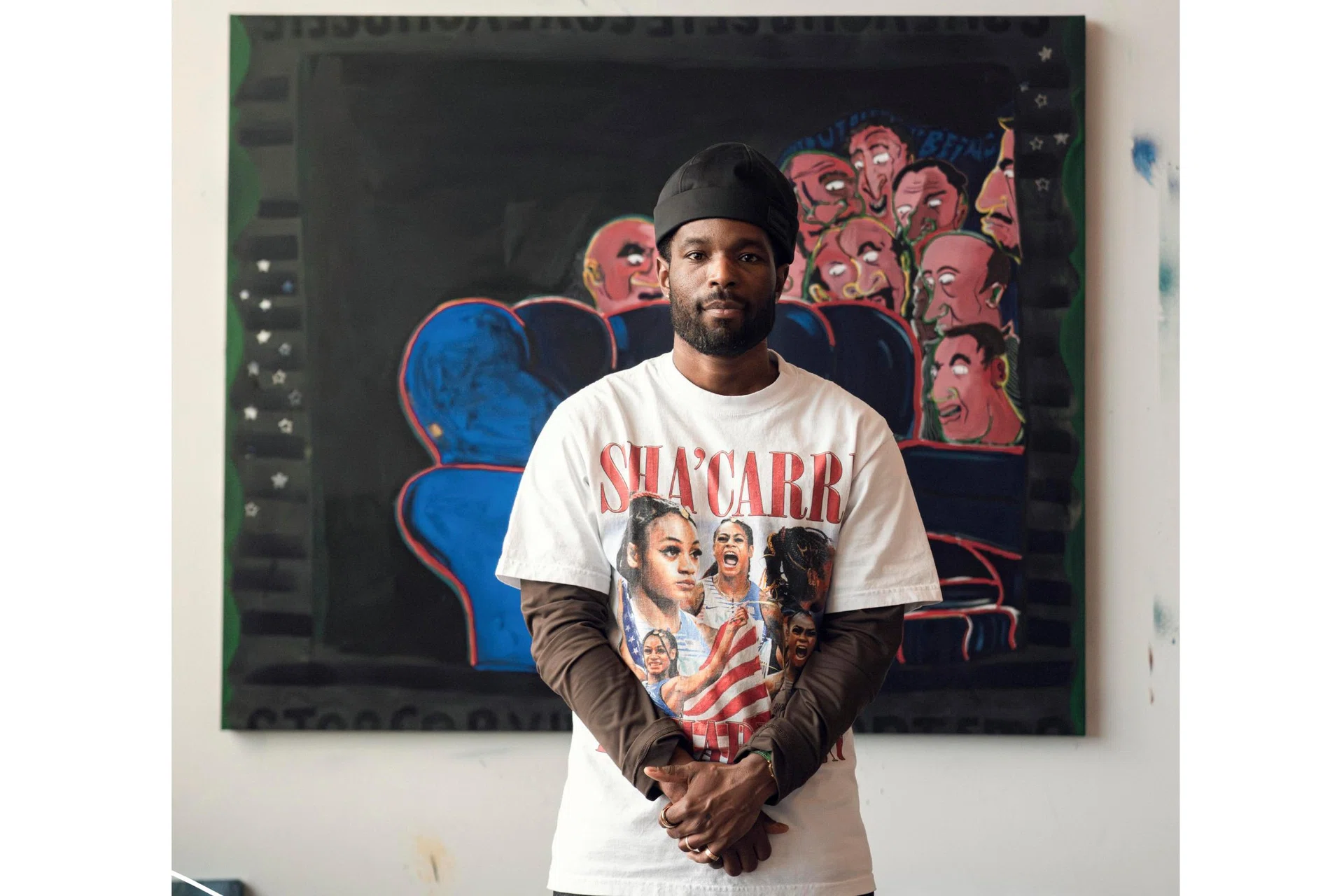
It took courage for Walter Price to move to New York and pursue a career as a painter, but he says his dream has come true
[NEW YORK] For an older generation of artists, serving in the military was a fairly common experience, one shared by Ellsworth Kelly, Robert Rauschenberg, Jasper Johns and others.
These days, Walter Price’s stint in the US Navy makes him something of an outlier.
The experience informs the contemporary painter’s work, and it is one of several elements that gives Price a distinct profile in today’s art world, as does his particular literary take on naming his works and his shows.
Price’s paintings plumb the zone where figuration melts in and out of abstraction, and the colour blue is his most frequently employed hue, but it is not necessarily used to imply melancholy.
“You do four years in the Navy, and you see a lot of blue water,” said Price, standing in his studio in the New York City borough of Brooklyn. “The neighbourhood I grew up in, people wore a lot of blue, too. But also it’s just like a colour I like.”
He noted: “It’s the most forgiving colour for a painter, I would say. You can get away with a lot with blue.”
Navigate Asia in
a new global order
Get the insights delivered to your inbox.
Price is a ball of tightly coiled energy. He was wearing a track suit with a swirling blue and green pattern, a palette that matched his paintings, and during an hour-long interview he declined to sit.
Not far from the many stacks of paintings in his studio were some weights, part of his training regimen.
“I set a goal before I turn 40 years old,” said Price, who is 37. “I should be bench-pressing 225 pounds.”
SEE ALSO
He is just as ambitious with his work, and some results of that drive are on view this month, in a show of 36 works at the Hong Kong branch of David Zwirner gallery, “Pearl Lines”, running from Tuesday (Mar 24) to May 9.
Price’s paintings plumb the zone where figuration melts in and out of abstraction, and the colour blue is his most frequently employed hue. PHOTO: NYTIMES
One of the works is a striking field of umbrella shapes, repeated with varied colours, titled “It has to rain before you can see where all the leaks are at” (2025).
Such repetition “exhausts” the image, Price said – and he meant that in a good way. “It’s a way to take something that’s figurative and push it into abstraction,” he explained.
The title of the work is from a passage in Octavia E Butler’s science-fiction novel The Parable of the Sower. Writerly references abound for Price; he’s a big fan of classical Russian novelists like Dostoyevsky, too. He often paints a word or phrase on the thin edge of a painting, nudging viewers to get up close and peer around the side if they want to read it.
On the edge of one work in the Hong Kong gallery show, he painted “Resistance is key!”
Dealer David Zwirner said that when he first saw a work by Price in 2022, in a show at his gallery curated by writer Hilton Als, he made an incorrect assumption.
“I was sure I was looking at an older artist who had been working for many years,” Zwirner said. (The artist said that it happened a lot because Walter Price was “an old man’s name”.)
At this week’s Art Basel Hong Kong fair, Zwirner’s booth features Price’s 2024 painting The sudden laughing intimacy of the streets.
For that work, Price employed paint and also drew with a chrome pen, as drawing is a foundational part of his practice. The base of the painting is not canvas but wood.
“I like the hard surface,” Price added. “You can collage, you can draw, and you can add more gesture and mark-making on it.”
Price had a solo show at the Walker Art Center in Minneapolis in 2024 called “Pearl Lines”, which is the same title as the Zwirner gallery show. Price’s interest in repetition goes beyond just images. Most of his shows have been titled “Pearl Lines”.
“With beautiful words, sometimes things need to be repeated,” Price said of the poetic reuse, but then he declined to explain further. “It has a personal meaning for me, but I don’t want to put that in The New York Times.” He laughed.
Price was raised in Macon, Georgia. “I grew up a typical small town person with big dreams,” he remembered. Although his family did not have a lot of money, he said the circumstances were not “sad poor”.
After graduating from high school, he went into the Navy, working as both a cook and a firefighter.
Both jobs contributed to mastering the “nonverbal communication” of painting, he said, including the dexterity for “working the small areas” of a painting.
Then he studied at the Art Institute of Washington and Middle Georgia College, using the GI Bill and getting an associate of arts degree from the latter institution.
Price was dead-set on moving to the big city to pursue art. One of his recurring and repeating motifs is the rounded arm of a cozy upholstered sofa or armchair. To Price, it is a painterly manifestation of a piece of advice from pastor and motivational speaker Eric Thomas about getting comfortable with being uncomfortable.
“I listened to that every day for a year before moving to New York City, because it was such a big thing,” Price said of Thomas’ line. “I needed to pump myself up.”
Now Price is enough of a known quantity that he actually has three galleries; in addition to Zwirner, he shows with Greene Naftali and Modern Art.
Some artists get stressed out if various dealers are asking them for work at the same time, but Price has a forthright approach that Zwirner characterised as “going right at the art world like an athlete playing in a league”.
Price pointed out that he feels comfortable with the game as it is. “I don’t feel pressure,” he added. “It’s a privilege to be here as a painter, and for my dream to come true is all I could ask for.” NYTIMES
Decoding Asia newsletter: your guide to navigating Asia in a new global order. Sign up here to get Decoding Asia newsletter. Delivered to your inbox. Free.
