


Editor’s note: The opinions of the smart, well-read women in my Denver book club mean a lot, and often determine what the rest of us choose to pile onto our bedside tables. So we asked them, and all Denver Post readers, to share their mini-reviews with you. Have any to offer? Email bellis@denverpost.com. – Barbara Ellis
‘Joyride,’ by Susan Orlean (Avid Reader Press, 2025)
‘Joyride,’ by Susan Orlean (Avid Reader Press, 2025)
In this generous memoir, the author gives us a candid look at her life, at how her irrepressible curiosity, her courage to explore topics about which she knew little, and her insatiable love of learning got her started as a writer. She reveals the early seeds that became important pieces, how her work began and moved past obstacles and unpleasant surprises, and how she turned those seeds into finished products. I especially enjoyed the stories of “The Orchid Thief” and the movie it became, and of “Rin Tin Tin.” Gossipy, but in a good way. What bookish person doesn’t want a vicarious, insider’s look at The New Yorker? This is a craft book for writers in that Orlean shares techniques that have worked for her, and also, by getting this wide-open look at the author, it’s easier to understand why her nonfiction is so appealing. And she doesn’t hesitate to describe her embarrassing moments and setbacks. It was her attitude, clearly, that unlocked so many doors. (Selected as a Best Book of the Year by Oprah, Time magazine and NPR.) — 3½ stars (out of 4); Michelle Nelson, Littleton
‘Keeper of Lost Children,’ by Sadeqa Johnson (37 INK, 2026)
A fictionalized account of an adoption program for biracial children of German women and Black American GIs born during the years of American military occupation following World War II, established by an African-American army wife and journalist. The story tracks three main characters: the indefatigable Army wife, one Black GI and his daughter, in both predictable and surprising plot lines. Despite many clichéd turns of phrase and some mangled German expressions, this novel lays bare and humanizes a little-examined truth of the aftermath of war. — 3 stars (out of 4); Kathleen Lance, Denver
“The Extraordinary Life of Sam Hell,” by Robert Dugoni (Lake Union Publishing, 2018)
‘The Extraordinary Life of Sam Hell,’ by Robert Dugoni (Lake Union, 2018)
Sam Hill is born with ocular albinism, that is, red pupils. It doesn’t take long for classmates to call him “devil boy” or for bullies to identify him as an easy target. His pain is mitigated by his friendship with Ernie Cantwell, the Catholic school’s only Black student. Ernie experiences parallel prejudices, despite being a star athlete. The two are joined by a cheeky girl named Mickie, who comes from a home torn by alcoholism. Chapters alternate between Sam as a boy and as a man, a strategy that allows the reader to be reassured that Sam will survive his childhood trials. Sam’s mother’s fallback position is that everything is God’s will, a belief that Sam will have to wrestle with on his own. Not a deep, literary work, but a satisfying read. — 3 stars (out of 4); Jo Calhoun, Denver
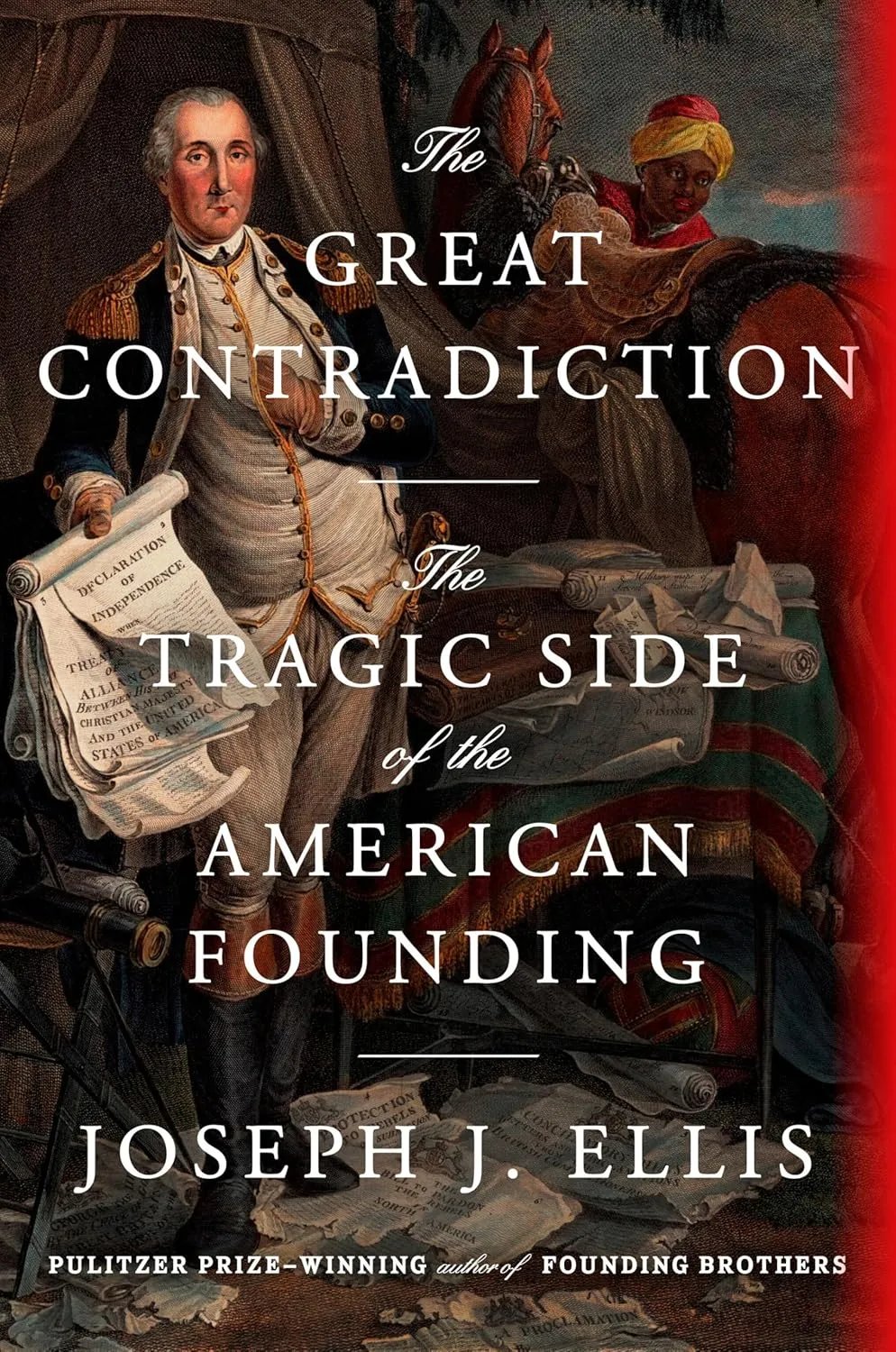
‘The Great Contradiction: The Tragic Side of the American Founding,’ by Joseph J. Ellis (Alfred A. Knopf, 2025)
Amid all the admiring, even nostalgic, books and films commemorating America’s revolutionary beginnings in the lead-up to our country’s 250th birthday, Ellis’ book examines the underside of that time, specifically the failure to end slavery, and the failure to avoid Indian removal. He devotes more space to the issue of abolition and emancipation, as in his words, the slavery debate had “a greater impact on the political and ideological values created at the American founding, including otherwise inexplicable compromised reached at the Constitutional Convention.” Less time is spent examining the contradictions and reversals in the treatment and displacement of Native Americans by the French, British and eventually by the American colonists, yet it is not any less tragic. He also strives to understand the ideals and realities that led our founders to their actions and compromises, many of which had far-reaching consequences. For 250 years later, we still haven’t resolved what it means to be a biracial or even multiracial society. — 3 1/2 stars (out of 4); Kathleen Lance, Denver
‘Elsewhere,’ by Gabrielle Zevin (Farrar, Strauss & Giroux, 2005)
Coming-of-age stories abound, but this one is different — perhaps because our heroine dies at 15 and her coming-of-age is in Elsewhere. You might even call it a coming-of-death story, but it’s far more upbeat than that implies. Liz Hall is struck by a taxi at 15, just when life is getting interesting. She’s transported by ship to Elsewhere, where once she accepts that she’s dead, she finds a new life, with friends and purpose. She grows into a woman even as she ages backwards. “A life isn’t measured in hours and minutes; it’s the quality, not the length.” Zevin writes gentle books, seemingly cozy but sneakily profound. Although marketed to Young Adults, I recommend this for anyone looking for a sweet read. (A Time magazine Best YA Book of All Time.) — 2 stars (out of 4); Neva Gronert, Parker
