


The question of who Banksy is has long been the art world’s favourite mystery.
Ever since the graffiti artist first crashed on to the art scene in the early 2000s, his works have received almost cult-like attention, garnering praise for their searing social commentary and political messages.
For decades, swirling speculation over the artist’s true identity – which was shrouded in mystery – created a layer of mythology around the pieces.
Whenever a new mural would emerge, fans would race to see it. In 2021, the artist was accused of causing “Banksy bedlam” on a residential street in Great Yarmouth used for one of the artist’s “Great British Spraycation” pieces.
People stop to admire Banksy’s ‘Great British Spraycation’ artwork in Great Yarmouth in 2021 – REUTERS/Peter Nicholls
In the global art market, such a feverish following has meant big money. Banksy pieces have traded at auction almost 9,000 times, according to art database Artnet.
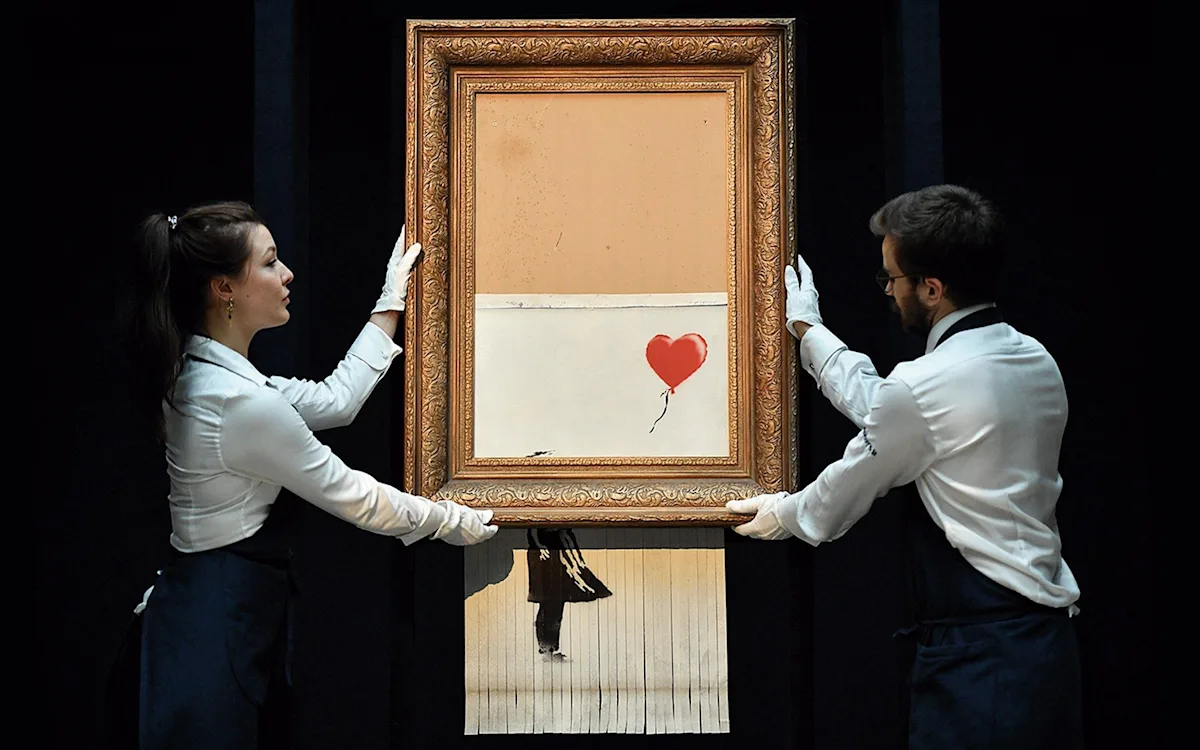
Sotheby’s sold a version of ‘Girl with a Balloon’ for more than £1m in 2018. As the hammer went down, the canvas began to drop through the frame, which was fitted with a shredder. Three years later, the resulting partially shredded piece – renamed ‘Love is in the Bin’ – sold for £18.5m. It set the record for the most expensive Banksy work ever sold.
Banksy was back in the spotlight last week, but it was his identity that was centre-stage.
Reuters claimed it had finally unmasked the artist, naming him as Robin Gunningham. The report said the smoking gun was a signed confession from the guerrilla artist himself.
Banksy’s company Pest Control Office declined to confirm or deny the story. However, it has left many asking what will happen to the artist’s brand.
No more mystique
“The art world’s reaction has been predictable,” says Guy Hepner, a gallerist. It has been “part voyeuristic excitement, part hand-wringing about what this means for his legacy”.
Hepner says that Banksy’s anonymity has meant the market for his work is unlike almost any other living artist.
“It operates on multiple tiers simultaneously — blue-chip print editions with strong secondary liquidity, unique in-situ street works that are essentially impossible to own, and the rare authenticated canvas or panel piece that commands serious institutional-level prices,” he says.
Practically speaking, if an artist’s identity is known, it tends to buoy sales in the secondary markets as collectors feel more confident to buy pieces when they know more about who created them.
But many say that for Banksy, being unmasked as a middle-aged man from Bristol may undermine the elusiveness that his brand feeds off.
“The mystery of the invisible man is central to his art and the natural inclination is to say that now he has been revealed, the magic will be gone,” says Thomas Woodham-Smith, co-founder of the Treasure House Fair in London.
Reuters has said Robin Gunningham is the artist known as Banksy – PETER RICKARDS
Some claim that the mystery around Banksy has been crucial to his success.
“At best it would keep it neutral or maybe slightly downgraded if more comes out about his character,” says one industry insider. “I don’t think the price is going to go up now because everyone knows who he is. It could have, if it turned out he was the lead singer of [trip hop band] Massive Attack, but he’s not. He is just a guy from Bristol.”
However, others argue it is not as simple as that. Banksy is not only a political agitator who stirs up the news agenda with his social commentaries, but also an artist who creates products for a market where authenticity and provenance are essential.
When Banksy’s real identity was unknown, there were suggestions of multiple artists and many works of questionable provenance which impacted the value of his overall oeuvre.
“Now there is provenance and identity behind his work, we can start to analyse him more as an artist and less as a political agitator,” says Woodham-Smith.
He suggests that Banksy now fits more neatly into the Brit-pack genre alongside artists such as Damien Hirst.
Still, Banksy is not one to be predictable. This week, few art experts were willing to say they knew what this would mean for Banksy’s work.
Art critic Ivan Macquisten says that, when Girl With a Balloon was shredded, his instant reaction was that Banksy would be in trouble if it could be shown he was responsible for destroying an artwork he no longer owned – especially as it had sold for so much. The same work went on to be sold for 17 times its sale price pre-shredding.
Banksy’s “Love is the Bin” sold for £16m in a 2021 auction – Haydon Perrior/Sotheby’s Auction House via AP
“It was a stroke of genius in two ways,” he says. “Banksy defying the market and at the same time boosting his own exposure and value. I’m actually critical of him for holding the market in contempt when it has played such a big part in building his legend, but I understand where he is coming from.”
Banksy’s next act
Others say that his identity was pretty much known already – the Mail on Sunday revealed him to be Gunningham in 2008.
“At this point, who really cares?” says artist and curator Kenny Schachter. “It’s like the existence of Santa – everyone knows, but nobody wants to know; they’d rather keep the romance alive.”
Damian Delahunty is an art dealer and curator who has bought, sold and advised on Banksy’s works for years.
Banksy is known for his political and provocative artwork – Julien’s Auctions/PA Wire
“This is not an artist who is motivated by money,” he says. “He could set up on a street corner selling art – like he did anonymously a few years ago in New York’s Central Park – and make millions, but he doesn’t.”
Delahunty says Banksy is incredibly philanthropic and only sells work when he needs to fund one of his quasi-political projects.
During the pandemic he donated a painting to a hospital in Southampton that went on to be sold for £15m at a Christie’s auction.
Elsewhere, he owns a hotel in Palestine’s West Bank called the Walled Off Hotel – a play on the name of the Waldorf chain. He also funds a rescue boat called the Louise Michel, which saves refugees encountering danger in the Mediterranean Sea.
“He is not visible at all, and that will not change,” Delahunty says. “Will he start turning up to the opening of shows? Absolutely not.”
While opinions on his legacy as a newly unmasked artist are divided, everyone now has a new question to ask: it is no longer who is Banksy, but what will Banksy do next?
Try full access to The Telegraph free today. Unlock their award-winning website and essential news app, plus useful tools and expert guides for your money, health and holidays.
