


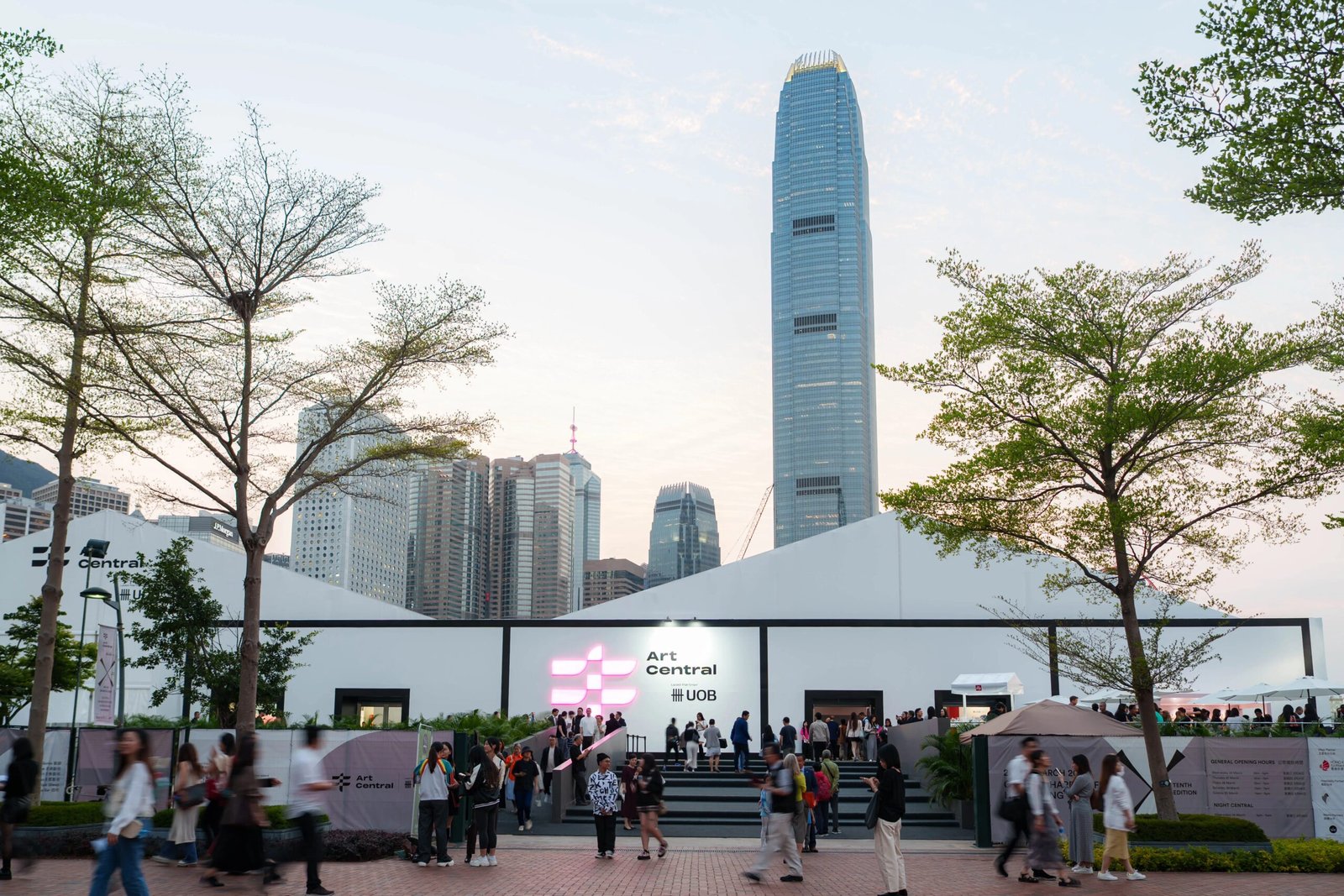
Art Central, the contemporary art fair in Hong Kong which returns for its eleventh edition at the iconic Central Harbourfront from 25–29 March 2026 (VIP Preview on 24 March). Courtesy of Art Central
Although it is widely known that Art Basel gave a big push to the growth of Hong Kong’s art scene, the international mega-fair was not the first to land in what is today the second art capital in the world and the number one art hub in Asia. In fact, Magnus Renfrew‘s ART HK was Hong Kong’s first major international art fair—one that would eventually give way to Art Basel Hong Kong after its acquisition by MHG Group in 2011. Four years later, the Hong Kong-based Asian Art Fairs Ltd. launched Art Central.
From the outset, Art Central was conceived as a satellite fair focused on emerging galleries, younger artists and curated projects as a way of ensuring the region was well represented—and not overshadowed by Art Basel—during Hong Kong Art Week. Later this month, the fair returns to the iconic Central Harbourfront with a record 117 galleries, and Observer spoke with director Corey Andrew Barr ahead of the opening about how Art Central has established itself as a site for discovering emerging and overlooked talent in Hong Kong and the broader region.
For him, the situation from the beginning was clear: the market was bigger than what Art Basel alone could represent. “The market needed it commercially, but it also needed a place where younger galleries and new galleries in Asia could get started, because that didn’t really exist at the time,” he said.
Now, after 10 editions, the fair serves two main groups of presenters. On one side are younger Asia-Pacific galleries seeking to establish a presence in Hong Kong, the region’s largest art market. For them, Art Central offers an important entry point into the city’s ecosystem. On the other side are international galleries—particularly from Europe and the United States—looking to introduce their artists to Asian audiences and develop relationships in the region. The first group makes up the bulk of the fair’s roster: about 80 percent of participating galleries are based in Asia, including 25 from Hong Kong, while the remaining 20 percent come from Western markets.
“The balance broadly reflects previous editions, although the Asian share is slightly higher this year,” Barr said, due in part to the rising cost of transporting artworks internationally. This year’s edition will see strong representation from South Korea, mainland China and Taiwan. Southeast Asia also plays a prominent role, with eight galleries from Indonesia participating. For visiting collectors from abroad, this mix presents a richer and more layered picture of Hong Kong’s artistic landscape and its relationship to the broader Asian art scene.
Corey Andrew Barr. Courtesy of Art Central
In just over 10 years, Art Central has undergone several transformations. Like much of Hong Kong’s cultural landscape, it was deeply affected by the pandemic, which lasted longer in the city than almost anywhere else. The fair returned to its Harbourfront location in 2024, and that homecoming also coincided with a shift in how it positioned itself. “It’s been very successful commercially, and it has a strong following among collectors and audiences,” Barr reflected. “But the question becomes: how do you make a platform like this sustainable? How do you keep it approachable? How do you make it respond to the next generation—not just of artists but also of collectors?”
Younger audiences, according to Barr, rarely replicate the habits of the previous generation. Instead, they require new forms of engagement and different points of entry into the art world, and Art Central’s role within Hong Kong’s ecosystem has gradually expanded as a result. This year, for instance, the fair is placing greater emphasis on its curatorial stance in addition to its role as a commercial platform. “We see ourselves as responsible for identifying those people who want to engage with art and giving them a platform to learn about it—to make connections, to meet artists, curators and other people in the field,” Barr said. The fair’s programs now include talks, encounters with artists and curators and activities that extend beyond the fair itself, from studio visits to trips across Hong Kong’s Greater Bay Area, encouraging deeper engagement and showing visitors more of the city.
The fair beyond the booths
For its 2026 edition, Art Central chose Europe-based curator and artist Enoch Cheng to guide the fair’s curated gallery program, and the fair is launching Central Stage, a new platform spotlighting six artists in Hong Kong whose practices have recently received significant institutional recognition. The selection for this first iteration includes Arahmaiani, Esther Mahlangu, Arno Rafael Minkkinen, the Japanese collective SIDE CORE, Elnaz Javani and Marta Frėjutė—a group reflecting a geographically diverse range of practices. Cheng is also behind the selection for Neo, the fair’s sector dedicated to young galleries presenting an artist who has never been shown at the fair before.
Alongside this gallery-focused programming is a parallel non-commercial creative program curated this year by Zoie Yung. Unfolding through installations, moving image, performances and on-site dialogues, it places particular emphasis on new digital dimensions, examining the frictions and intimacies that shape contemporary social and virtual life through the work of Asian voices and influential practitioners shaping the region’s cultural landscape.
At its 11th edition, Art Central continues to position itself as a discovery-focused fair, highlighting emerging galleries and experimental practices during Hong Kong art week. Courtesy of Art Central
Among the fair’s other highlights is a central special commission, Kaitlyn Hau’s Recursive Feedback Ritual 0.01 (2026), a large-scale installation and motion-capture performance that furthers the artist’s exploration of the emotional, perceptual and technological dimensions of digital embodiment. The performance program, Endless Night and Midnight Sun, will feature a series of commissioned works inspired by the extreme cycles of light and darkness in polar regions as a metaphor for our shifting sense of duration in the altered temporalities of the A.I. era. The artists included are mostly from Hong Kong and the surrounding region; among them are Jiaming Liao, Chaklam Ng, Isabella Is a Bella and Susie Au.
The fair will also feature Reading the Room, a section dedicated to moving-image practices from the region and beyond, bringing together video artists exploring the subtleties of human interaction and the labor of meaning-making as altered by artificial intelligence. Among them are several well-known names in new media, such as Jon Rafman, whose Cloudy Heart – Strawberry Moon (2025) centers on an A.I.-generated bedroom-pop star whose “e-girl” persona unfolds across social media feeds, music and algorithmic aesthetics, blending video art and new digital subcultures close to local audiences.
New media and new audiences
“We’re seeing more interest in digital practices,” Barr acknowledged, noting that several galleries this year are presenting digital work and that the fair has been encouraging participants to experiment with hybrid presentations that mix digital and physical media. “Hong Kong artists are especially adept at exploring the connections between digital culture and contemporary art, and they’re thinking about those relationships in very smart ways. We certainly see that presence within the artistic community here.” Still, he admits that digital work remains less visible on the commercial side of the market. “Collecting in Hong Kong tends, overall, to be a bit more conservative than in places like New York or London. In terms of the global art capitals, Hong Kong usually sits around number two or three, depending on the ranking, but the collecting culture can still lean toward more traditional forms.”
With a new emphasis on digital practices, the fair’s central special commission this year presents Kaitlyn Hau’s Recursive Feedback Ritual 0.01 (2026), a large-scale installation and motion-capture performance that furthers the artist’s exploration of the emotional, perceptual and technological dimensions of digital embodiment. Courtesy of Art Central
“Our platform operates in both Chinese and English, so we’re facing the Chinese ecosystem while also speaking directly to the international community. That’s something quite special about our DNA—the ability to interface between all of these arenas and bring all of these people together in one place at the same moment.”
In cities such as Hong Kong and Seoul, younger audiences are already highly engaged with contemporary art, and the challenge is less about generating interest than about creating platforms that can deepen that curiosity into meaningful participation. “I think the next generation of collectors wants more context around the art,” he added. “They’re not just looking for an asset that will increase in value—it has to be much more than that now. So we need to do a better job explaining the context of the work. What is the story behind it? What conversations does it belong to?” An art fair like this, he argues, can serve as an introduction to the broader critical context and cultural conversation in which these artworks and artists participate. “We’ve found that approach to be quite successful. It also simply makes the fair more exciting when there are different kinds of things happening throughout the event.”
When asked about expectations for this edition given the current market climate in Asia and internationally, Barr didn’t shy away from situating the fair within a broader climate of uncertainty. Over the past two years, collectors in Asia have shown a degree of caution that reflects wider economic conditions. In mainland China in particular, the property crisis has contributed to a sense of hesitation among buyers. “They may still be very wealthy and fully capable of buying art, but it hasn’t necessarily felt like the moment to spend that money,” he explained.
After two years of caution driven by broader economic uncertainty—and in mainland China by the lingering effects of the property crisis—collectors across Asia are beginning to return to the market, bringing a renewed sense of optimism to Hong Kong’s art week. Doris Wong Wai Yin. Courtesy of the artist
Despite that cautious mood, however, collectors are still buying art. Surveys of participating galleries show they have been selling more works, just at slightly lower price points. For Barr, that dynamic aligns well with Art Central’s market positioning. “The value proposition at Art Central isn’t as high as at some other fairs, so collectors don’t come with the expectation that they need to spend very large amounts of money,” Barr said. “At the same time, it’s not an Affordable Art Fair; that’s not our approach. We have works across a wide range of price points, and that range gives collectors flexibility, which is exactly what they’re looking for right now.”
Barr did admit that the atmosphere may be shifting. Conversations with galleries—particularly those with strong ties to mainland China—suggest that some collectors are gradually becoming more willing to spend again after two years of restraint: “Because many collectors have largely maintained their wealth during that time, there now seems to be slightly less of that caution than before.” Hong Kong, he added, will ultimately serve as an important barometer for the region’s market and the broader health of the Asian market. “We’ll have to wait and see what happens at the end of March. It’s still a bit of a question mark, but my feeling is that collectors may be finding fewer reasons to hold back from spending.”
