


Get kids reading fluently. As much as you can. Have them read and write about books.
That, more or less, is the key to translating the science of reading into classroom practice, according to a new book by Doug Lemov, Colleen Driggs and Erica Woolway called The Teach Like a Champion Guide to the Science of Reading. The authors work together at Teach Like a Champion, an organization built on Lemov’s bestselling books by the same name.
The new volume is meant to be a practical guide for classroom teachers. It offers concrete tips and embedded QR codes that take readers to videos of teachers putting those strategies into practice.
The authors are attempting to tackle a big problem: how to boost students’ knowledge. They cite research suggesting that books — even children’s books — use more uncommon words than come up in most adults’ conversations. In practice, that means, “most of the words a student learns in their lifetime will be learned via encountering them in their reading.” The more kids read, and the wider variety of books they are exposed to, the better off they’ll be.
When people hear the “science of reading,” they might (mistakenly) equate it with phonics, but the authors spend little time on those core foundational skills. In fact, they take systematic phonics instruction in grades K-3 as the assumed starting point for literacy instruction and note that their book is about “the science of reading beyond phonics (emphasis theirs).”
This is an important shift. In recent years, students have made impressive gains on early reading skills, thanks in part to widespread changes in state policy pushing for new curriculum and early screening assessments. Meanwhile, fourth and eighth grade reading scores continue to decline, and 12th grade reading comprehension recently fell to all-time lows.
Lemov, Driggs and Woolway suggest this is partly an assessment problem. If students can’t answer a question about a reading passage, that may be due to many potential problems. It might be because they didn’t understand the question … or they lacked key background knowledge embedded in the text … or they didn’t understand the vocabulary words … or the passage used an unfamiliar syntax that the student couldn’t follow.
While daunting, this multitude of potential reading challenges also helps provide a roadmap for improvements.
From Tasks to Meaning: How to Make Sure Reading Instruction Goes Deeper
Lemov, Driggs and Woolway start with a critical foundation: attention. They note that, “You can only learn about what you are paying attention to. Attention is always a prerequisite to learning.” But reading and books are losing the war for kids’ time and attention. That’s partly why the authors support a “high text, low tech” approach to limiting distractions in schools, and why Lemov was an early champion of school cellphone bans.
So how can teachers get kids immersed in reading? It’s not as simple as putting good books in front of students, because if they can’t read the words on the page quickly and easily, they will struggle to comprehend and make meaning out of the text. The authors cite an Italian study that found, “reading fluency predicted all school marks in all literacy-based subjects, with reading rapidity being the most important predictor.”
In response, the authors suggest that, “The best way by far to improve fluency is to provide students opportunities to hear, read and reread text aloud.” They cite the strong research evidence behind the practice of repeated reading, which has positive impacts even for high school students.
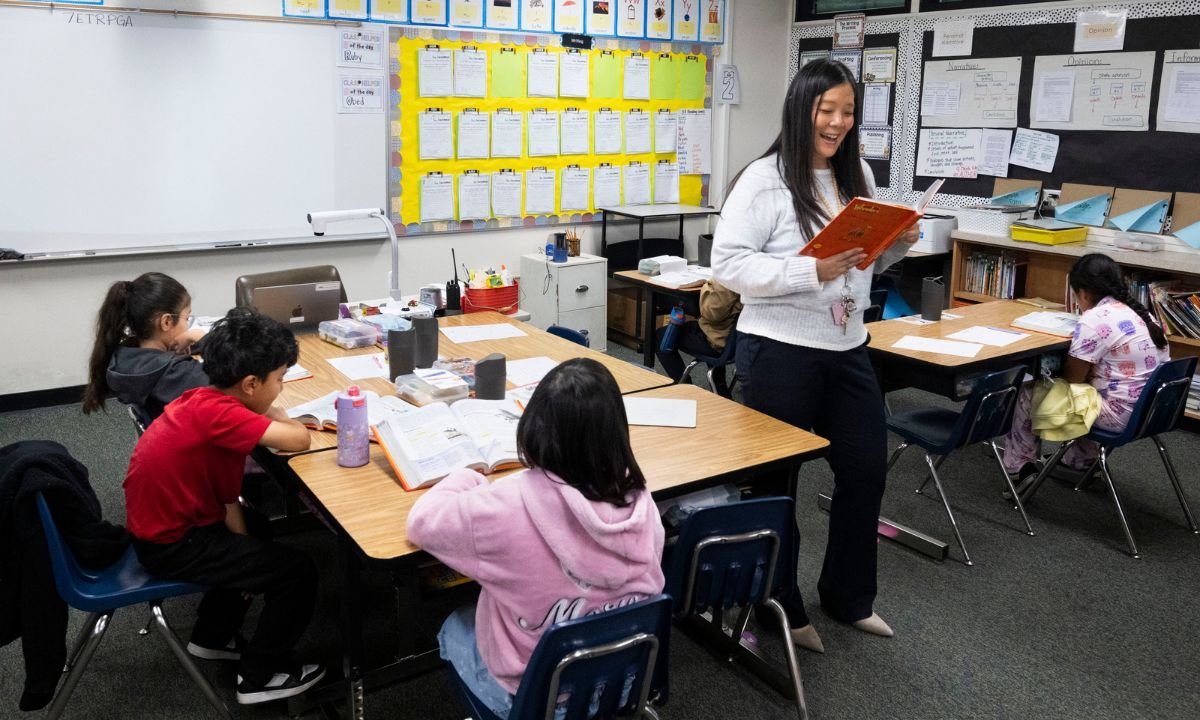
Lemov, Driggs and Woolway devote a full chapter to how educators can put this research into practice, including teacher and student read-alouds, along with carefully constructed and monitored independent student reading time. For instance, a teacher helping children learn how to pronounce a new word during a read-aloud might say: “That word is pejorative. Try that: pejorative. Good. Pejorative means expressing disapproval.” This type of repetition can help students store the new word in long-term memory. In scientific terms, this process is called “orthographic mapping” and it’s a key component of how readers train their brains to connect words with their meaning.
Writing can also help students develop into strong readers, particularly when it’s tied to what they are already learning. But not just any writing; students need to be explicitly taught how to structure sentences, use precise vocabulary and write with style and panache. Drawing on concepts from The Writing Revolution, the authors suggest that teachers deploy “Because, But, So” exercises to help students extend their initial responses to explain why something is happening, any complicating factors and the final outcome.
Report: In Some Urban Districts, Science of Reading Limits ‘Robust Comprehension’
Recently, there’s been a lot of debate in the literacy world about whether students should be taught to read using whole books or if it’s fine to mix books and excerpts or other short passages. On one side, researcher Tim Shanahan argues there’s no evidence that whole books are superior to excerpts at building reading ability or do more to build student reading stamina. He also notes that excerpts allow for greater breadth than a single book that may offer more in depth.
Lemov, Driggs and Woolway are unapologetic advocates for Team Book. They approvingly cite dyslexia researcher Maryanne Wolf’s warnings about how digital technologies are reshaping our brains, and how deep reading can counter those effects. They point out that stories help readers remember things better than just a series of disjointed facts and figures. And, channeling E.D. Hirsch, they value the collective culture capital that students can access when they have read Shakespeare’s plays or George Orwell’s dystopian novels.
Regardless of which side of this argument you find more persuasive, Lemov, Driggs and Woolway have done teachers a service by providing numerous tips and examples of how to put the science of reading into practice in their classrooms.
