


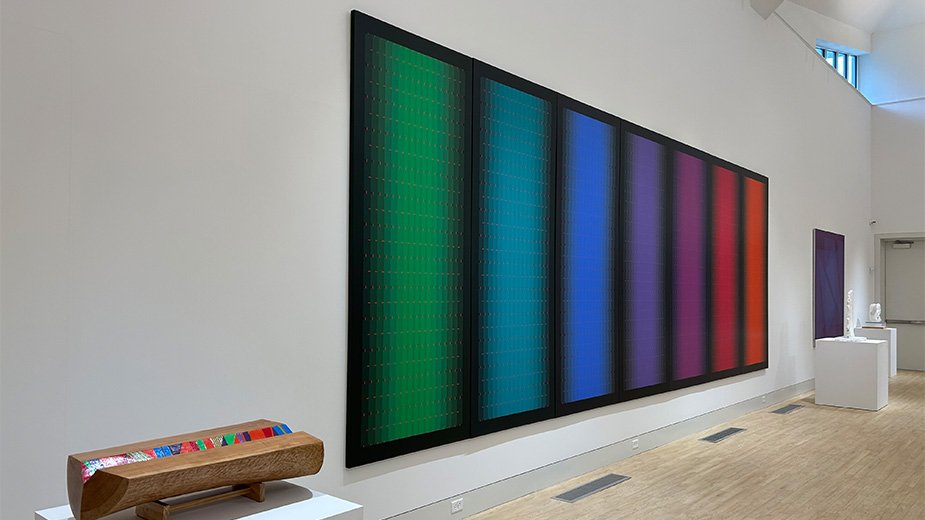
HOWLAND, Ohio – A new exhibition at the Medici Museum of Art spotlights the massive and mesmerizing paintings by a founder of the Op Art movement.
The show includes 22 pieces by the late Julian Stanczak and 26 sculptures by his widow, Barbara.
A grand opening of the exhibition, and two others at the museum, will take place from 4-7 p.m. March 21. All three are currently open for viewing by visitors.
Stanczak was a central figure in the Op Art school, which was prominent in the 1960s and ’70s. His abstract style uses colors and repetitive shapes to play tricks on the eye.
“Op Art deals with our perception of color and light,” said Katelyn Amendolara-Russo, executive director of the museum. “It’s an optical illusion. You’re going to see that the colors play with one another, and they kind of jump out at you. It plays tricks on your eye, and it’s kind of disorienting to look at some of these pieces up close.”
Stanczak was born in Poland in 1928. He and his family spent time in a Siberian labor camp during World War II, where an accident cost him the use of his right arm, which was his dominant arm. The artist would then train himself to paint with his left arm.
Stanczak and his family escaped the camp when he was 16, and he eventually wound up in Uganda. It was there that he found artistic inspiration in the geometric patterns on the textiles that Ugandan women used to make clothing.
Stanczak emigrated to the United States in 1960, settling in Cleveland. He earned degrees from the Cleveland Institute of Art and Yale University.
He moved to Cincinnati where he became an art instructor at the Cincinnati Art Academy. That’s where he met his future wife, Barbara, a native of Germany, who was one of his students.
The two would later move to the Cleveland suburb of Seven Hills, where Stanczak died in 2017.
Barbara, 84, worked with the Medici Museum to mount the exhibition.
“[The exhibit] celebrates Barbara and Julian’s creativity as a couple,” Russo said. “I invite people to come in and spend time with the works, especially to see the contrast between Barbara as a sculptor and Julian as a painter.”
The pieces of both artists are interspersed in the spacious and high-walled galleries at the south end of the museum.
Because Op Art has a permanent place in the visual art world, museum visitors might sense a degree of familiarity upon seeing Stanczak’s works.
The artist is considered a major American painter, and his works are coveted.
“His work is widely collected,” Russo said.
The exhibition is not only eye-catching, but unusual in its content. “This is the first time the Stanczak Foundation is exhibiting the largest paintings he ever created,” Russo said. Some of the pieces are at least 20 feet wide.
The exhibition might see further life in other cities, as Barbara has given permission for other museums to display it after its run at the Medici closes in July. Russo is attempting to find another museum that would be a suitable destination.
It took two years of effort to make the exhibition a reality.
“I was always aware that the Stanczak Foundation mounted shows, and it was always a goal of John Anderson [the museum’s former executive director who died in 2025] to have this show,” Russo said. “It’s great to see it come to fruition.”
Russo expects art lovers will travel from many states to see the exhibition.
“We’ve had inquiries internationally about it,” she said. “Stanczak’s work has a huge international footprint.”
Other Exhibitions
The other two Medici exhibitions that will formally open March 21 feature the works of acclaimed sculptor Barbara Ségal and budding painter Ross Pino.
Ségal, who lives and works in New York, uses her art to engage the world of fashion. She is widely known for her colorful sculptures that look exactly like oversized women’s designer handbags.
Ségal also creates stone sculptures of intricate dresses on a female torso with amazing intricacy. The stone has the delicacy of lace and fine cloth.
A sculpture of a handbag by Barbara Ségal.
Examples of both are in the Medici exhibition.
“You’ll see a whole retrospective of her work in the show,” Russo said.
Two of her handbag sculptures, one an oversized depiction of a Chanel bag, are in the show. These items are in great demand by collectors.
“[Ségal] is celebrated a lot in contemporary sculpture,” Russo said. “She is collected a lot by private collectors such as Malcolm Forbes, [the rapper] Drake, [pop music artist] Rihanna, Steven Cohen and Leslie Wexner. They are attracted mainly to the handbag sculptures.”
Still, it is the artist’s stone sculptures that are most revered.
“She makes stone look like fabric, right down to the stitches,” Russo said. “She is masterful at depicting cloth material in marble and stone.”
“Rock Star,” a painting by emerging New York artist Ross Pino.
The third artist whose work is on exhibit is also a New Yorker. Pino lives in Brooklyn, where he is a popular contemporary artist.
He was selected by the Feuerman Foundation, as part of its effort to support emerging artists, for the Medici show. Russo is a board member of the foundation, launched by renowned superrealist sculptor Carole Feuerman.
Skulls and skeletons are frequently depicted in Pino’s colorful art.
“His work has undertones of Basquiat,” Russo said. “It deals with the duality of life, the theme of life and death.”
The Ségal exhibit and the Pino exhibit will both close at the end of May.
Pictured at top: A massive Op Art painting by Julian Stanczak at the Medici Museum of Art. A sculpture by the late artist’s wife, Barbara, is at left.
