


Ed. note: This conversation appeared in the weekly Book Pages newsletter. Get it for free here.
This week, I get to share my conversation with one of the country’s finest authors, Louise Erdrich. A Pulitzer Prize and National Book Award winner – and a serious candidate for a Nobel Prize, right? – Erdrich has just published her first book of short stories in two decades, “Python’s Kiss.” And it’s excellent.
We talked about a lot of things: the book, her writing process and, of course, her dog, and I’ve included a gift link so you can read her thoughtful, moving and often very funny responses. Erdrich, an enrolled citizen of the Turtle Mountain Band of Chippewa Indians of North Dakota, was generous with her time and a total delight to talk to.
SEE ALSO: Like books? Get our free Book Pages newsletter about bestsellers, authors and more
“There’s always a place in the story where it’s like touching a magic spring in a lockbox, and all of a sudden, you have the rest of the story. It shows you what’s going to happen,” says Erdrich, describing the writing of some of the stories.
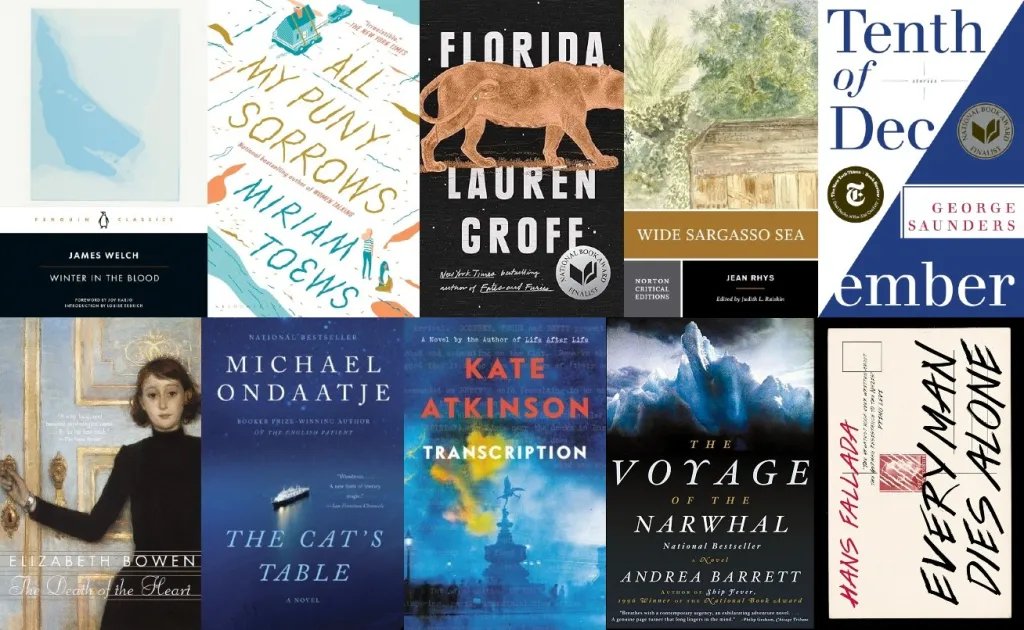
And since there was so much to discuss, I’m including her recommendations for books she loves to reread, which she gathered from her shelves as we talked. I’ve already ordered a few of these from the library, and I suspect you might as well.
Thanks, as always, for reading.
Louise Erdrich, winner of the National Book Award and Pulitzer Prize for her novels, is the author of “Python’s Kiss,” a book of short stories. (Photo credit Pallas Erdrich / Courtesy of Harper)
During our interview, we started discussing books we return to reread, and Erdrich, a bookstore owner as well as a celebrated author, went to her shelves to share some of her favorites.
Q. I’ve read a lot of the stories in “Python’s Kiss” more than once, and I imagine I will revisit them again. Are there stories that you reread?
Right now, I’m reading Lauren Groff’s new collection of stories, “Brawler.” I love Lauren Groff’s stories. I liked [her earlier collection] “Florida” so much. There’s one in there that I go back to all the time, and I think there’s going to be several stories from this new book that I’ll be reading over and over. I have books that I go back to all the time and reread.
Q. Which ones?
[looking at her bookshelves] Other writers, I always imagine that they have these walls of books that are organized, and a desk that is just pristine. I always think that other writers are … more orderly.
I have a list and a shelf of the novels that I read over and over. “The Death of the Heart” by Elizabeth Bowen. “Wide Sargasso Sea” by Jean Rhys. I love that one.
SEE ALSO: Where’s the nearest bookstore? See our map of 80+ SoCal bookshops
And one that I hope people read during these times is “Every Man Dies Alone” by Hans Fallada. A real story, but it reads like a novel, “Every Man Dies Alone” is about a couple whose son is killed in World War II. They live in Germany, and they decide to do what they can to resist what’s happening. It is a true story. It feels like what they do is so small, but it’s enough to get them killed. I think it’s really important to read that book.
“Tenth of December,” I love George Saunders’s books.
There’s a story, I think it’s in “Nights at the Circus” by Angela Carter, and it’s about Lizzie Borden, and it’s really good – it’s terrifying. [laughs] “Dubliners,” I read that.
You know who I really love? Miriam Toews’s “All My Puny Sorrows.” That’s great. And “Winter in the Blood,” James Welch’s book. I read that over and over, and every time, I forget how good it is, even though I know it’s going to be good.
Q. I heard that you also read Mick Herron’s Slow Horses books. He’s a favorite of mine, also.
Oh, I really love them. [laughs] Yeah, yeah, the [Apple+] series is a very good adaptation as well. I like spy novels. I have all the John le Carré, Graham Greene, – and Kate Atkinson did a spy novel that was excellent, “Transcription.” It was at the highest level.
Q. Spy novels and detective fiction can seem comforting in challenging times because someone is figuring things out and setting things right.
I think that’s it. Someone’s going to solve this. Someone has the courage to look into this and the intelligence to solve it.
Oh, one of the other books is Michael Ondaatje’s book, “The Cat’s Table.” I’m going on a little trip, and I’m taking it with me because I love that book and its world. And then I just read Andrea Barrett’s book, “The Voyage of the Narwhal” again.
SEE ALSO: Get book recommendations and stories about bestsellers and authors in our book section
Q. Oh, I don’t know that one.
Ohhhh, you’d like it, yeah. I read it again because it was in the world of the movie “Frankenstein” – the polar expeditions that were going north, these crazy undertakings, and the ships being iced-in for years at a time.
I was at the bookstore, and at the top shelf of the children’s section, there was a book about Shackleton’s voyage for children, and I thought, What? I mean, at least it’s not the story of The Terror and The Erebus. [Ed. note: No survivors were found from those two ships.]
But that’s what “The Voyage of the Narwhal” is about. That kind of expedition, but it’s surprising because it also includes Inuit people. It’s a terrific book.
Q. Have you read or watched the TV adaptation of Dan Simmons’ “The Terror”? It’s developed a following among those who love stories of ships caught in the ice.
It’s a genre for sure! It’s a really fascinating genre, I mean, I also love all the Patrick O’Brian books, and, you know, seafaring books, but you know they’re going to end up in ice when they start to the north. Even though you know the whole story, you kind of want to read it again. It’s like “The Ministry of Time,” you’ve read that, right? I like that book, too.
