


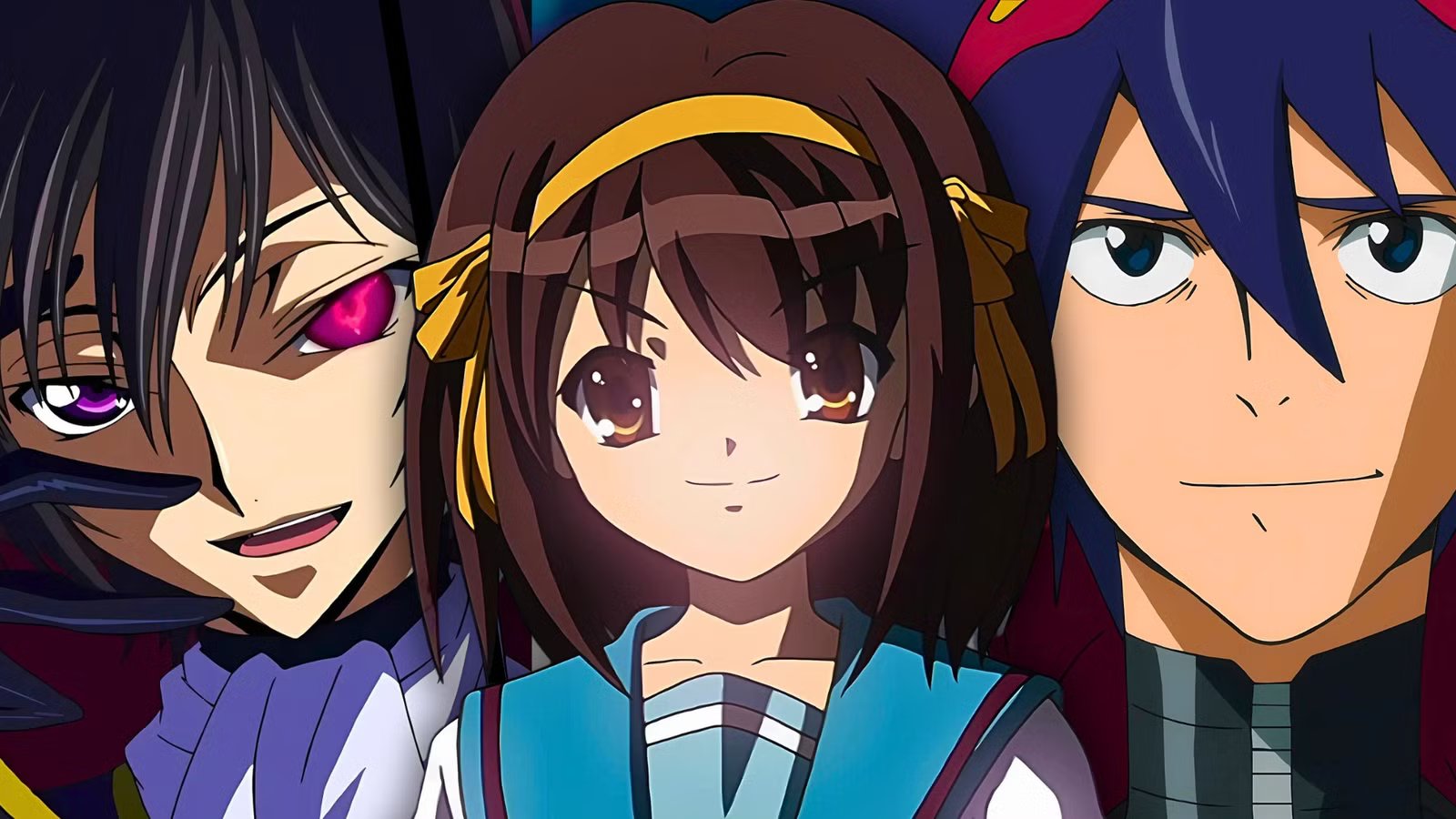
The 2000s remain one of the biggest decades in anime history for Western audiences. Thanks to Toonami, Adult Swim, and the proliferation of the internet, anime fandom began rapidly expanding. The medium was even getting popular enough for series to come over from Japan almost immediately after they aired instead of being years behind.
Some of the biggest anime were battle shonen, but shoujo and slice-of-life series also surfaced to get attention as well. While some of these series don’t have the same popularity they had at the time, they still caused waves in anime fandom that are still relevant today.
Yu-Gi-Oh Turned The Focus From Monster Capturing To Card Games
Yu-Gi-Oh! Duel Monsters showing Yugi drawing a card.Image via Studio Gallop
Amidst the popularity of Pokémon and Digimon, Yu-Gi-Oh! launched in 2000, and kick-started a craze of its own. The original Yu-Gi-Oh! Duel Monsters saw teenaged Yugi Mutou battling it out in deadly card games to find a way to help his shadowy partner Atem finally pass on to the afterlife. Yet while Yu-Gi-Oh‘s original series ended after a couple of years, its legacy lived on.
The Yu-Gi-Oh! series quickly turned into a franchise, with Yu-Gi-Oh! GX and Yu-Gi-Oh! 5D’s being major parts of the 2000s as well. Meanwhile, the game quickly turned into a massive TCG for players worldwide.
Naruto Gave Fans The Ultimate Heated Rivalry
Masashi Kishimoto’s Naruto got its anime adaptation in 2002, and made its way to the West in 2005. The series turned into a smash hit on both sides of the Pacific almost instantly, with Kishimoto creating the ultimate underdog in Naruto Uzumaki, a young kid who sought out acknowledgment from his village by seeking to become the Hokage.
Naruto was a large part of the reason the 2000s became so oriented towards battle shonen. While other series would’ve simply ended after catching up to their manga, Naruto was popular enough that they did two years worth of filler before deciding to switch it up and re-launch the series as Naruto Shipuuden. Naruto didn’t just define the 2000s, but the 2010s as well, as both Shipuuden and Boruto became major series in the following decade.
Fullmetal Alchemist 2003Image via BONES
When people think of Fullmetal Alchemist, they tend to think of the 2009 series Fullmetal Alchemist: Brotherhood. In fact, it’s entirely possible that modern fans don’t even know there was a previous series, given that the 2003 series is almost impossible to legally watch these days. However, make no mistake: without BONES’ Fullmetal Alchemist in 2003, there would be no Brotherhood.
The 2003 version of Fullmetal Alchemist was incredibly popular both in Japan and the West, as the series enjoyed a prime spot on Adult Swim at the time. While the story wasn’t “manga-accurate”, it gave viewers precious character development episodes that made certain plot-relevant deaths even more impactful. And the series’ success both led to a film and the eventual remake at the end of the decade.
Bleach’s Aesthetics and Drip Are Unmatched
Though high schooler Ichigo Kurosaki spent his entire life seeing spirits from the afterlife, it’s a chance encounter that leads to him becoming a Soul Reaper, a being with the power to help spirits pass into the afterlife. That’s the basic plot of Bleach, which quickly became one of the biggest anime series of the 2000s, rapidly becoming part of the west’s Big Three of anime.
Bleach creator Tite Kubo is responsible for some of the best character designs of the 2000s, with his influence on modern mangaka clear even in popular series like Jujutsu Kaisen. One of a handful of “long-running” anime, Bleach managed to run for over 350 episodes before coming to an end, just shy of getting its last arc adapted. Still, the series was so beloved that, in 2022, the series managed to return as Bleach: The Thousand-Year Blood War, which not only finished adapting the manga, but introduced the franchise to a new generation.
Fate/Stay Night Became One Of Anime’s Biggest Franchises
Fate-Stay Night 2006Image via Studio DEEN
In 2006, Studio DEEN released Fate/Stay Night, an adaptation of one of the routes in Kinoko Nasu’s visual novel game. Taking place in a universe where a secret society of mages engage in a war over the Holy Grail, Fate/Stay Night was a massive success as a visual novel. Unsurprisingly, the anime turned into a success as well, as fans became captivated by the universe’s world and writing.
While Fate/Stay Night was briefly known in the anime community for a hilarious fansub meme, it wasn’t long before the series was turned into a massively successful franchise. Just a few short years after its release, other animation studios rushed to adapt the visual novel’s other routes. Meanwhile, spin-offs and prequel anime continued to grow the series’ popularity, turning it into one of the biggest franchises of the era.
Ouran High School Host Club Became A Hit Even Without Being On Television
Ouran Host High School ClubImage via BONES
Sadly, even the best shoujo anime don’t often achieve the popularity they deserve in anime fandom. However, Ouran Host High School Club is a notable exception to the rule, and still stands as one of the best reverse harem anime series. The series follows high school student Haruhi Fujioka after they’re forced to spend their off hours working at an all-male host-club to pay off a vase they destroyed. There’s just one problem: Haruhi’s actually a girl, meaning she has to keep her gender concealed while continuing to work off her debt.
Ouran Host High School Club is a truly special series. Most anime from the 2000s that never aired on television in the West have long been forgotten, unless they managed to become popular enough to become a franchise themselves. However, Ouran has maintained both its popularity and its sterling reputation even decades after airing.
Code Geass Turned Into The Biggest Mecha Anime of the 2000s
Whether mecha fans like it or not, Code Geass is the most recognizable mecha anime that isn’t Gundam. The series follows Lelouch Lamperouge, a young man with dreams of getting revenge for the murder of his mother, who one day gains the power to make anyone obey his commands. From there, Code Geass’ absurd yet endlessly entertaining story unfolds.
Code Geass is the rare series where viewers really had no idea where it was going next, as episodes could hop between comedy fanservice and stunning betrayals with ease. Lelouch himself is one of the most ridiculous yet compelling protagonists of the 2000s, as a true villain protagonist was a massive departure from what fans were used to at the time. Code Geass was so popular that, even though it had a clear ending, they still found a way to turn it into a franchise.
Death Note Helped Young Fans Realize The Medium Could Do More Than Battle Series
Light and Ryuk look sideways at something in Death Note
After airing on Adult Swim in the West in 2007, Death Note quickly turned into a massive hit. It broke the rules of what was expected of anime by casual audiences in so many ways, offering a reminder that the medium was truly limitless. For starters, in the midst of an era full of battle shonen, Death Note was a series that didn’t need flashy fights, instead relying on mystery and thriller elements to capture fans.
Death Note gave audiences a true villain protagonist with zero redeeming qualities. Light Yagami is a legitimately terrible person, yet the series keeps viewers interested in how his story will turn out. Despite never getting a proper sequel, there’s a reason anime fans still talk about this series decades later.
The Melancholy of Haruhi Suzumiya Was A Global Sensation
melancholy of haruhi suzumiya ending themeKyoto Animation
There’s no denying that the 2000s were the decade of action series for anime. However, there were a handful of series that broke away from that mold and managed to still gain an audience. The comedy slice-of-life series Haruhi Suzumiya was one such series, following the adventures of a group of high-school students who formed a club for the purpose of discovering the supernatural.
While younger fans might not remember it, The Melancholy of Haruhi Suzumiya was one of the biggest anime of 2000s anime culture. A massive global success, fans at conventions often gathered together to do the dance choreography from the series’ end theme. Honestly, it probably could’ve continued to grow its popularity if it could’ve found a better way to air its second season’s “Endless Eight” arc.
Lucky Star Helped Slice Of Life Become A Major Genre
Lucky Star is another of those series that isn’t talked about with the same reverence as long-runner shonen anime, but is arguably just as influential. The series was a slice of life that followed a group of high school girls in their day-to-day life. Like Haruhi Suzumiya, Lucky Star connected with the hardcore anime fans even without ever making it onto television.
Also like Haruhi, Lucky Star helped popularize the concept of both slice-of-life anime, and the “Cute Girls Doing Cute Things” genre. This created a shift in anime culture for the next several years, as slice-of-life anime dominated the latter part of the 2000s and the early 2010s. Series like K-ON and Yuru Camp all owe their success to Lucky Star.
